Showing posts with label review. Show all posts

Thursday, January 19, 2023

Just Don't

I watched the first two episodes of the Night Court reboot? Revival? Whatever you want to call it. While I don't believe this series is anywhere near or will become the classic the original 1984-1992 series was, it wasn't that bad. Starring Melissa Rauch (The Big Bang Theory) and John Larroquette, Rauch plays Judge Abigail "Abby" Stone, the daughter of former night court judge Harry Stone. Abby is just as optimistic as her father and it's a shame that the court system is just as jaded as it was back in the 80s. I get these are TV shows but still.

Judge Stone persuades former Assistant District Attorney Dan Fielding (Larroquette) to return to the night court as a public defender. He makes it clear that this is only temporary. Larroquette is still adeptly able to play Dan Fielding and his droll wit, yelps, and physical comedy harken back to those original nine seasons. Abby and Dan are joined by ADA Olivia (India de Beaufort), court clerk Neil (Kapir Talwalkar), and bailiff Donna "Gurgs" Gurganous (Lacretta). Apparently, no one has a last name.

The cast is all good. Like I said, this show has potential and my major criticisms could all be washed away in a couple episodes. First, we don't really know the characters. What little we know about them really came from a psychic that was being arraigned shortly after the show began. In the original series, we learned about the characters through the way they talked to each other when discussing the newly appointed judge. And keep in mind that 3 of those 6 characters would be gone by the end of the second season. The other thing is they relied way to heavily on the original series. The pilot was filled with nods and inside jokes from the original series that would pass over the heads of people who aren't familiar with the show. This was tamed down with the second episode but it's strange that the spirit of Judge Harry Stone (or Harry Anderson) hangs so heavy on the series. Again, all that could change next week.

One scene, when Abby was trying to convince Dan to return to the night court and he asks "Why me?" Taking a beat, Abby responds "Because there's no one else." A sad reminder of the passing of both Anderson and Markie Post, who played public defender Christine Sullivan.

I recommend checking this series out (Tuesday at 7PM CST on NBC, streaming next day on Peacock), if only to see how it expands and improves on the original series, which is very outdated in a lot of ways. But I also recommend the original show which you can find on FreeVee.

October 25, 1973
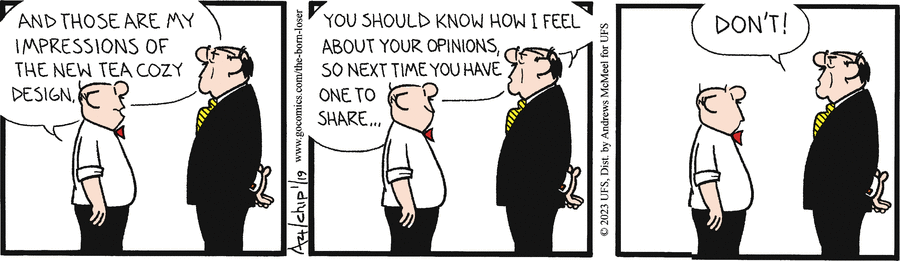
Is Brutus really going to buy clothes from guys that wear those pants? And that tie? The 70s were wild, man!

I'm assuming that it's not really Brutus' job to care about the tea cozy designs, it's just his job to help sell them. You would think that Brutus would've already been yelled at about sharing his opinions and that he would just stop doing that.

Some people never learn...

Friday, January 31, 2014

Gone Girl

The last time a book really pulled me into its world and had me wanting to turn each and every page as quickly as possible was "Looking For Alaska" by John Green which I read in 2012. Before that, "Drood" by Dan Simmons which I read in 2009. It's not very often that a book does that. I can be entertained by reading without having to be completely immersed in the world the author has created and in love with every character. In fact, the most recent book that did this, doesn't even have likable characters, let alone lovable ones.

"Gone Girl" by Gillian Flynn is the story of Nick and Amy Dunne, a married couple who have hit a rough patch in not only their marriage but life as well. Nick and Amy are about to celebrate their fifth wedding anniversary when Amy goes missing. As per usual, Nick is considered the prime suspect even though he didn't do anything but the fact that he's a less than perfect husband begins catching up with him.

It's honestly really hard to talk about this book without giving any of it away but after Amy vanishes, the reader quickly learns what actually happened. What really bothered me about the book is with the exception of a couple people, all the blame is placed on Nick which makes sense up to a point but one would think that after awhile the police would realize that Nick isn't really acting like someone who just disposed of his wife and they would start looking for new leads. But the lead investigators are from the small town of fictional North Carthage, Missouri along the Mississippi (not to be confused with the real Carthage, Missouri near Joplin) so their investigative skills are more than likely very lacking.

The best part is that Amy is treated just as badly as Nick sooner or later but there's no happy ending for this story. If anything, the story of these two people just wind up getting sadder. It's a wonderful, perverse look into the lives of two psychopaths. As much as you want to hate it, you can't help but getting sucked in.

I also recommend reading "Gone Girl" before the movie comes out. The movie, starring Ben Affleck, Rosamund Pike and Neil Patrick Harris, will be out October 2014 and was recently showcased in a creepily-cool Entertainment Weekly cover.

Until next time, I remain...
~Brian

Monday, January 13, 2014

The Fault In This Book

There are a couple books that I want to review on here but, to be honest, I worry about posting any type of actual criticism on the Internet these days. It's not as if the reviews are going to be scathing or anything but actual valid criticisms can still upset people whose goal in life seem to be making the Internet into a whitewashed feel-goodery. It happens more on some sites than others but seemingly having an opinion outside of what the hivemind has already pre-approved is a major no-no and people will call you out on it.

Maybe it's because I'm not an actual critic so I'm just spouting my opinion and criticism just because I can and think that makes me a better person, I don't know. I'm just trying to get people to read my stuff. The same people who spout the value of being able to do what you love and want are the same people who want to stop any form of criticism that goes against what they love and want. Also, I tend to comment on things made by professionals who should be able to handle criticism not 14-year-olds who just posted a story they wrote when they were 8 and are asking people to "be kind."

The first I want to review is John Green's The Fault In Our Stars which is a very good book and well worth a read but I do think it falls far from Green's Looking for Alaska, which I read first and consider one of the best books I have ever read. In fact, just a cursory search of criticism on TFIOS, people have the same complaints as I do of what's going on the scene is described in detail meaning the character's thoughts and emotions are talked about it instead of inferred, the characters are your typical know-it-all teenagers who think the world is ridiculous and there's something keeping the two characters who should be together apart. The something in this case is cancer.

Hazel Lancaster is a 16-year-old cancer patient who is forced by her parents to attend a support group for kids living with cancer which is where she is introduced to Augustus "Gus" Waters. Hazel and Gus start, I guess you could call it dating, and Gus even uses his "Make-a-Wish" wish on getting Hazel to meet her favorite author in Amsterdam. The meeting does not go very well and the rest of the book is dealing with trying to remedy that. Green has said that TFIOS is completely different from his other books in that "it’s narrated by a girl; she is not in high school; her concerns are somewhat different from the concerns of my previous protagonists; etc." The main character/narrator may not be in high school but she is still of high school age and the only concern different from his other protagonists is the cancer which is treated just like any other type of concern high schoolers/teenagers have. I'll admit that I have known very few people with disabilities and diseases and that includes cancer but what happens in books, anything fiction really, is that they all say they want to belong and be treated normally but seem to refuse to actually do anything to belong and be treated normally. Hazel and Gus do this repeatedly throughout the book. Hazel has a high school friend who you see a couple times in the story but it seems to just be as a reminder to the audience that Hazel, at 16, is an adult and no longer in high school. It may also just be a reminder that these characters are sick which I think is worse in that it shoves their disease down our throat.

The other thing I noticed is that Gus is only a character through Hazel's eyes so we really only ever get her side of Gus. I've seen arguments online about whether or not Gus is a Manic Pixie Dream Girl or, in this case, a Manic Pixie Dream Boy. A MPDG/B is a character with "no discernible inner life, and usually only exists to provide the protagonist some important life lessons." When Gus is not with Hazel we don't know what his life is like and we never really learn what he wants out of life outside of Hazel. Even towards the end, Gus is only ever doing things for Hazel. And I understand that he wants to be remembered but I feel that was just added in to justify him doing all this for Hazel. Any hopes and dreams and life Gus had immediately got pushed to the side after meeting Hazel.

I also understand that I am not the target audience but I still think TFIOS is a decent read. It's entertaining and a fairly quick read so it won't take up much of your time and it does keep you wanting to know more but I would recommend Looking for Alaska as I still think about that one. Maybe if I read TFIOS first I'd place it higher on the pedestal but I can't change that now.

John Green's website is here.
You can order The Fault In Our Stars and other John Green books here.

Until next time, I remain...
~Brian

Monday, March 12, 2012

Brutus Is a 14-Year-Old Girl

I went to see "The Lorax" this weekend with my wife and son. I hadn't read the book since I was probably in Kindergarten. It was really good. I was glad that despite the ads focusing on Zac Efron and Taylor Swift, the movie was really about Danny DeVito (the Lorax) and Ed Helms (the Once-ler). I get the movie has a liberal, "let's save the environment" story to it, which, of course, has angered Conservatives and people in big business.

Who the hell has a problem with trees? Clearly this person who posted a comment on Amazon in reference to the book:
First of all, I'm glad that you aren't above going to library to borrow books because the library is a liberal concept. Offering free books to people so that they can read and become educated--shudder. Secondly, did you not know what The Lorax was about? Also, do you not know that most everything Dr. Seuss has written has a liberal undertone? Also, did you know that Dr. Seuss' earliest job was creating war propaganda for the United States during World War II?

And the fact that you are resorting to insulting the language in the book is laughable. It's a book for children and the point of creating the word "biggerer" instead of using "bigger" is because Seuss used unique and made-up words to tell his stories and "biggerer" fit the poetic pattern better. The book is a poem, remember.

And if you don't want your children reading things with a liberal bias then you will be screening an awful lot of books, TV shows and movies because most everything out there has a liberal bias and most people making that stuff have liberal leanings. Maybe you should, instead of policing your children on stuff that is supposed to entertain them, let them figure it out themselves.

And do you really want to read a children's book that has the opposite message of "The Lorax"? Where it's okay to chop down trees, ruin the environment and essentially destroy the planet as long as you make money? That's the thing about children, they aren't stupid. They're going to question why the tree has to be cut down. "Can't the Once-ler find something else to make his Thneed?" "Why isn't he replanting trees to replace the ones he cut down?" From my experience as a kid, being around kids, raising kids and being around more kids is that kids love trees. And I've also learned that if you don't like trees, you are in the minority.

Anyway, "The Lorax" is a really good movie and it doesn't drag out like so many other kids' movies (I'm looking at you Pixar) but if you don't like being lectured, having lessons beat over your head or pro-environment talking points sung to you, then you probably won't enjoy the movie.

Brutus has mentioned on numerous occasions that he is a loser. To me, it's reminiscent of someone on Facebook posting this as a status: "Why do I even try? Sometimes I wish I could disappear forever." and then having 27 people comment on it, begging the person not to kill themselves or whatever they are thinking but then commenting, long after people have concluded they have killed themselves that "It's a song lyric" or "It's from a TV show" or "I just dropped my glass of milk and was sad about it." It's over-dramatic and mainly just to gain attention.

Friday, March 09, 2012

Then What's With the Apron?

A few months ago, I came across an article of fifteen apps writers must have. One of those apps was Evernote, an app that could save brief notes, large descriptions, pictures and audio. I downloaded the app because I thought it was something that may actually get some use from. I also thought it would be handy for when I am away from my computer and needed to make quick notes because not only does Evernote save the notes on your phone, it also syncs it up with Evernote's web service and Evernote's desktop program so no matter where you are, you have access to your notes. You can even purchase an upgrade to gain access to your notes offline.

I originally used Evernote to just jot down ideas for stories but I soon began using Evernote for when I go out to cemeteries and keeping all my history notes easily accessible. I also use it to remind me what I want to write about on my blog. But all of this is just the beginning of what Evernote can do.

One feature I just found on Evernote is CallTrunk, an extension that can record your phone calls and stores them on the web so you can listen to them later, annotate them, download them or delete them. I don't see where I would need something like that but for business people, I could see that being used when away from the office. And there are dozens of other apps and extensions that can be used with Evernote to make your note-taking endeavors even more amazing.

I downloaded the Evernote app in January and it has quickly become my second most used app on my phone. After Angry Birds I'm kind of ashamed to admit. So head over to the Evernote website and take a look at everything they have. If you are interested in diligent note-taking or even just keeping track of things you see on the Internet, Evernote can help you out.

I'd like to think that Gladys just wanders her house while Brutus and Wilberforce are at work and school wearing her apron even when she is nowhere near the kitchen. It's images like that that help me through the day and put a smile on my face.

Monday, July 04, 2011

#236: Sleep Well, and stay where I put you

I finished reading Graveminder by Melissa Marr which I wanted to read because of the cover. The cover really grabbed me and aside from a problem I described early on, it was a decent book. The plot of the book is the town of Claysville made a deal with who they thought was the Devil to not get sick. In return, people have to die so others can live and if the dead people are not minded, they come back to live to feast on the living so I guess they become zombies, or something similar.

The minding part is what the book is really about. Rebekkah Barrow is called back to Claysville after her step-grandmother, Maylene, is found dead. Rebekkah remembers that Maylene used to take her to the town's cemeteries, sprinkle some sort of liquid over the graves and say a "prayer": "Sleep well, and stay where I put you". You would think that would be a decent enough plot. A woman thrown into something she doesn't want to do and doesn't really know what to do trying to track down dead people wandering around the town. Sounds kind of intriguing but that's where the intriguing part ends.

Melissa Marr is known more for her Wicked Lovely series of books aimed toward the Twilight audience. Marr's first mistake, in my opinion, is the convoluted backstory the two main characters. While it was interesting at first, it became all those two characters talked about for chapters. Even when they were starting to make love (at least they made love in my mind). The next mistake was taking too damn long to catch the one dead person roaming the streets. I won't give away details but I don't know why it took as long as it did except that without the chase the book would've only been about 220 pages.

It was a decent story but it wasn't executed like it should've been. Instead of being a horror/thriller novel like one would think, Graveminder ended up being bogged by silly relationship banter that more deservedly belong in the Wicked Lovely series.

Wednesday, June 22, 2011

Shocked He Didn't Take Taxes and Interest Too

I joined a book club created by a local bookstore and our first book was The Bible Salesman by Clyde Edgerton. It was a really good book although I enjoyed the chapters focusing on the past than the main story dealing with the FBI. The cat and snake scene near the beginning of the book make the book worth reading through although it doesn't hold up to that scene as well.

I was so excited that this week would showcase Brutus on a plane heading to God knows where to save the Acme account but apparently a two-part lead up is all we get as today, Brutus is back at work--or at least his definition of work.


Even to a powerful businessman like Rancid W. Veeblefester, the American dollar is worthless. Veeblefester will be voting for either Santorum or Romney (whoever gets the nomination) because Obama has not fulfilled his promise of fixing this economy. Also because of his skin color...

Here are a list of reasons Brutus can't use the dollar in the vending machine: Machine is out of change, bill reader is broken, dollar is too crumpled and faded to be read, the machine is one of those ultra-rare machines that only takes coins, Brutus doesn't know the machine can give change. If I've missed any let me know.

Thursday, June 16, 2011

#233: It Was the Best of Books...

I finally got around to reading two books from my favorite authors. A Tale of Two Cities by Charles Dickens and The Winter of Our Discontent by John Steinbeck. I tried to get through Discontent first because it was the shorter of the two. Discontent was Steinbeck's last completed novel before he died. And I tried to get through it. I did. But, and I'm going to be frank here, it's not good. I love Steinbeck. I've read everything from Cup of Gold to The Acts of King Arthur and His Noble Knights and Discontent is not his best. The people do not sound like people and none of the characters really grab you except for maybe Margie Young-Hunt and that's probably because you are waiting for a nude and/or sex scene from her that you know will not happen.

The story is about Ethan Allan Hawley who decides to make things better for his family by basically becoming as unscrupulous as everyone else in America. Steinbeck was really reaching in this novel you can tell. Steinbeck was focusing on how much America had changed after World War II and it had changed but unlike Steinbeck's previous novels, Discontent shoved the moral down our throat. All the dialogue seems hackneyed and unbelievable and while I admit that a lot of Steinbeck dialogue seems ingenuine and stilted, this novel seemed to use it in abundance. I stopped reading about halfway through.

However I forced myself to read and finish A Tale of Two Cities because you constantly hear that it is the best of Dickens' books and if often quoted and assigned in high school. People can typically quote from Two Cities without ever having read it.  It was good. I don't consider it the best. Bleak House is still my favorite and I even consider the unfinished Mystery of Edwin Drood to be better but I can see how Two Cities is constantly lauded.

The novel is historical fiction and tells the story of Doctor Manette who is released from the Bastille and reunited with his daughter who becomes entangled in a love triangle with Charles Darnay and Sydney Carton. The characters soon get caught up in the French Revolution and, as with all love triangles, only one may get the girl. It took awhile for me to get into Two Cities but once I got the Revolution part, the book really sped up and seemed to take no time at all to finish. My only problem with this book, as well as any other book by Dickens is he cannot write a love story. It doesn't seem real, it doesn't capture your imagination and it is definitely not romantic. This may be because Dickens was not romantic to his wife, Catherine, who he blamed his ten children on and his subsequent financial worries. Dickens was, probably, more romantic to the young woman he had started dating shortly before begin Two Cities, Ellen Ternan and it is clear Lucie Manette is based on young Ellen.

Out of these two books, A Tale of Two Cities is definitely the better investment of the two. But I would recommend Bleak House and East of Eden over either of these tomes.

Friday, May 20, 2011

A Review of the Best Apocalypse Ever*

*The book, not the actual apocalypse.

The Underfold, which sounds like some sort of skin flap located around the perineum, had it's humble beginnings as drawings on index cards at a church in 2008 and since then it is becoming a web comic known around the world. Best Apocalypse Ever is a collection of Underfold strips showcasing early strips and the Zombie Apocalypse of 2010. One of the more interesting things about collections like this is the evolution of the strip. Admit it, it is interesting to see how Calvin and Hobbes evolved from more cartoon-y drawings into a beautifully watercolored work of art of its later years or how Charlie Brown transformed from a wide eyed kid with a big head to a slightly chubby boy and into the version we know now.

It's not quite Calvin and Hobbes but you can hardly tell the difference.
The Underfold features Brian, a fictionalized version of creator Brian Russell; JB, Brian's friend whose face is never shown and is covered with a paper bag--a bio-electric facebag to be exact. The early strips feature mainly back and forths between Brian and JB usually about random things including the reason for the comics, geek-dom topics such as Lost, Heroes and comic books. Within time, more people are introduced including Julius Reynolds (a crazy old man with a Facebook), JB's son Fred and Eye, which is Brian's eye after it was cut out by Fred. (It won't sound any less confusing in the book.)
I'm hoping this is a homage to Knightfall.

The relationship between Brian and JB remind me of the relationship between me and my best friend. We get along good but it's kind of a hassle to be each others friend and there is a slight possibility that we hate each other and talk bad about each other behind each others backs. A prime example is when JB is talking with Fred and Fred asks how JB can stand Brian because "he just keeps talking and talking [...] It's horrible!" which is a phrase I'm sure I've used explaining my friend to my wife. And we all know the best thing about books, movies and TV shows is when we see a little bit of ourselves in the characters.

The introduction of Fred.
A little more than halfway through the book, Brian and JB begin bouncing through various times and dimensions including a world drawn in crayon, CBS's The Amazing Race and a dimension where birds are the dominant species and humans fly. And then the comic starts to get weird. Brian's goatee comes to life and JB gets irritated with the storyline so he resets the strip. *Cough* After the reset, life returns to normal for Brian, JB, Fred and Eye. At least normal for the Underfold.
Eye breaks the fourth wall.

The four-panel strips are my favorite. I am a sucker for standard comic strip joke-a-day formats. It harkens back to a bygone era where four-panel newspaper comic strips were actually funny and not the watered down dreck currently permeating people's retinas. The Zombie Apocalypse comes and goes, we got an homage to the Terminator series of movies and then a murderous robot assassin attempts to kill Baby Jesus which is something I wrote about several years ago. So it's clear that at some point in 1993, Brian Russell rifled through my trash and stole my idea. My attorney, Lionel Hutz, is looking into it.

The art is simplistic but it is better than anything that I could do. Each character is drawn uniquely and are more than expressive enough. Even JB and he has a bag over his head. The character to really grab my attention was, of course, Eye. Eye, who is an eye with arms and legs, always speaks in the third person, replacing word like "I'm" and "I'll" with "Eye'm" and "Eye'll". It makes perfect sense if you don't think about it too long which is the way to really understand The Underfold. Brian says in the book that he is bad at endings and wrapping things up but if you don't think about it then everything makes perfect sense.

Sadistic Bag Puppet sounds like another web comic.
They are.
The book ends on Christmas 2010. There is something for everyone in this book. At least everyone if you are under the age 35. Let's face it, older people don't understand things like this. Only the really cool or really perverted ones do. But after you have ordered your copy of The Underfold, you need to head over to theunderfold.com and get caught up and find comics that were not included in the book. It's the only right thing to do. And when the real Zombie Apocalypse happens, you don't want Brian to hand you over to the zombies because he found out you don't read his comic do you?

Eye thought not.

I wonder this myself.

Tuesday, December 01, 2009

The Original of Laura

Vladimir Nabokov is in my top three favorite authors right after Michael Chabon and John Steinbeck. The first book of his I read was Lolita and since then I've read all of his short stories ("The Vane Sisters" having a profound affect on me) and finished reading Ada not that long ago. Nabokov has a unique voice that no other author has or ever will. The Original of Laura, written during the last three years of Nabokov's life, has all the markings of a great Nabokov tome however, since the novel is unfinished it leaves the reader (or at least me) greatly dissatisfied.

To clarify, Laura is far from unfinished. Unfinished, to me, means some form of cohesion and editorial input. This "novel" doesn't really have either. The story is left almost exactly as the author left it with asterisks or brackets placed throughout the book giving further clarity for what Nabokov was writing. The story was copied directly from notecards Nabokov wrote on and from what I could tell, only the first chapter had been completed with various other chapters in random stages of incompleteness. While there are references to plot threads and people that have made Nabokov's works famous (underage sex, family scandal and a oddly reminescent character named Hubert H. Hubert), there is no soul to the work although there is heart.

I borrowed the book from my local library and when I realized it was an unfinished work, I figured the novel would be very thin but instead there was a 300-page monster waiting for me. The way the book was printed is unique in that the book reproduces Nabokov's notecards at the top of every page while the text below the card reprints in type what the cards say. The left hand side of every page is blank and, here's the really odd part, the cards are perforated so you can pull the cards out and rearrange them ("just like Nabokov might have done"). I worry what this kind of feature will do to library copies of the book not just through bad eggs pulling the cards out but just normal wear and tear.

When Nabokov died, he specifically asked for the cards to be burned which is something his wife didn't do and, obviously, something his son, Dmitri, didn't do. Laura will either become a huge literary event or an example of adhering to an old man's dying wish. I don't know if the book should've been published, I think, had I been in Dmitri's position, I also would've published the cards. The book, from what people had gathered, is about Laura, who is married to an increasingly unattractive man named Phillipp Wild. A book about Laura has been published by one of her former lovers and it creates kind of a scandal. The book also ruminates a lot about growing older and death which leads us to the subtitle: Dying Is Fun. Death has pock-marked this story with Phillipp ranting about how his body is falling apart and he's getting closer to death. Given the time period of these writings, one could allude that in certain paragraphs Nabokov himself has possessed Wild when he goes off on a tangent about death.

This book is not for everyone. While I will suggest Lolita, Ada, Pale Fire and his short stories to other people wanting to read Nabokov, The Original of Laura is a book specifically for true Nabokov fans and literary enthusiasts.

Thursday, September 10, 2009

DC Is Dead...Long Live DC.

Since 2005, DC Comics has been trying to rebrand itself and become a leader in comic book properties. For years, DC has lost out to Marvel in both comic books and movies--although television is one thing DC tends to get right--and Warner Bros. is apparently sick of it.

It has been announced that the woman, Diane Nelson, who oversees the highly popular (and profitable) "Harry Potter" franchise is becoming President and Publisher of DC Comics and that DC Comics is now going to be called DC Entertainment Inc. (although I think they should've called it DC Media). So what all does this mean and where does DC go from here?

Paul Levitz, the now-former president and publisher will be retained as an executive consultant and Dan Didio will stay on as Vice President and Executive Editor. DC has constantly been criticized for being too slow to get new movies and other properties out unlike Marvel. DC tends to pick and choose which characters to use in their properties over-saturating the population with Batman and Superman stuff while generally ignoring properties like Green Lantern, Flash and Captain Marvel. Yes, people want to see the more popular characters but there are a lot of unused characters out there that could definitely hold a movie or television show (Resurrection Man).

I'm hoping what this means is that Warner Bros. will now use DC to it's full advantage and not treat it like the bastard child it's been in the past. Warner Bros. has a full slew of properties they could use for televisions and movies if they'd been willing to spend the money. Currently DC/Warner Bros. has Jonah Hex and Green Lantern green-lit and scheduled to come out. Next will be another Batman movie, Superman movie and possibly a Wonder Woman movie. DC needs to quit pickin' and pawin' at their franchises and begin writing these movies so in a five years or so there can be a massive JLA movie. They also need to start using some other characters to begin selling as pilots for TV networks.

Television is a place DC has done a better job than Marvel. From the very beginning you had The Adventures of Superman, then Wonder Woman, Shazam!, Isis, The Flash, Lois and Clark, Birds of Prey, Smallville and now two incarnations of The Human Target. Not to mention all of the animated series DC has had over the years. DC needs to use that medium to bring different characters into the foreground and introduce them to a new generation, unlike in the comics where you now have to know decades of history to know where they come from and why they haven't been seen since 1997.

One thing I notice in the comments about this story is what will really happen to the comic book production side of DC, will it remain independent or will Warner Bros. begin sticking their fingers into the pie? I honestly hope they begin going through the comics and forcing them to make major changes. Who honestly thinks having 5,000 different Earths is a good thing? "Crisis on Infinite Earths" changed everything to make it simpler. And it was simple: Everything before 1985, except for the Justice Society of America, never happened. I'm going through the comics now and wondering why are there four different Batmans? That is just stupid and it turns me off from reading. At least with Marvel, the 1960s Spider-Man is the same Spider-Man. DC, unfortunately, needs to have another "Crisis" to fix everything that they have broken--which may be what they are leading to--and I would actually read that and maybe get back into reading DC comics.

Another aspect is that Warner Bros. got tired of the PR that Disney/Marvel had been receiving as of late and basically did this to get their name out there. Back in 2005, when DC changed it's logo, it was to brand all of the DC properties under the same logo which is essentially the same thing as renaming DC Comics to DC Entertainment (note that Marvel is called Marvel Entertainment). DC has the potential to make Warner Bros. a lot of money and Warner Bros. has finally realized that. People should look at this like Warner Bros. is finally starting to give a damn about DC and that is never a bad thing.

Friday, September 04, 2009

Drood: A Review

Charles Dickens died on June 9, 1870 which left his novel, The Mystery of Edwin Drood, unfinished and a mystery itself. What Dan Simmons does in Drood is take real life accounts of what happened during the last five years of Dickens life and place a mystical and surreal character named Drood in the middle of it.

Dickens is nearing the end of writing his novel Our Mutual Friend when on June 9, 1865 he, along with his companion Ellen Ternan and her mother, were involved in the Staplehurst rail crash. It is there Dickens meets the strange character known as Drood--who Dickens becomes somewhat obsessive about. The novel mainly focuses on Wilkie Collins, a contemporary of Dickens and fellow author, and him slowing being driven insane by Dickens and Drood.

Collins is thrust into Drood's lifestyle because Dickens wants to research Drood for possibly a book. Soon, Charles Frederick Field, a former police chief, begins harassing Collins to follow Dickens into Drood's lair deep beneath an old cemetery and to show him how to get to Drood's lair. Collins begins by taking all this with a grain of salt and a slight sense of humor about it until he comes face to face with Drood himself. Collins is then infected with a scarab that begins moving around his brain and both Collins and Field determine that Drood wants Dickens to write a kind of biography about Drood and his teachings.

Dickens continues to live his life his way, uninterrupted by Drood or Inspector Field's persistent harassment. Dickens begins meeting Drood on every anniversary of Staplehurst and touring England and America giving readings of his novels. While Collins seems to be near death throughout the novel, Dickens seems to be getting younger.

Drood finally takes it's toll on Dickens and Collins decides to rid himself of Drood by killing Dickens. Collins plans the whole thing but on the day he decides to do it, Drood's minions stop him and tell him that they will take care of Dickens.

We never see Drood and we are given several explanations as to Drood's exsistance--ramblings of an insane Inspector Field, a story idea for Dickens, the effects of Collins constant laudanum usage, a real yet mysterious figure--but none are ever firmly established as the true Drood. The mystery of Drood is forever buried in Westminster Abbey, known only to Dickens himself, just like his unfinished novel.

Thursday, January 01, 2009

#174: Christmas Is Over

I have had four Christmases this year. I am all Christmas'd out. The first Christmas was on the December 24th with my family; the second on December 25th with my fiancee's family; the third was on December 26th with my fiancee and the fourth was today for my son.

Every Christmas I read Art Spiegelman's Maus. It is, by far, one of the greatest novels ever written. And it's in comic book form. I can't remember how I came to discover Maus but it was really the only Christmas present I wanted in, I believe, 1996. I got them and have read them every year because it's so personal. I've read a lot of books about the Holocaust and it is so beautifully written and illustrated and, because it does use pictures, you are able to see the horror of Auschwitz. While seeing these things happen to cartoon-like mice might negate the experience, it is a powerful story nonetheless.

The story opens when Art is a young boy in Rego Park, New York. He's skating with some friends when his skate breaks. He falls, skins his knee and his friends skate off without him, laughing at him. He returns home to his father, Vladek, who says "Lock them in a room without food and you'll see what it is, friends" and that echoes through the story through the whole time. Vladek and his wife, Anja, are constantly being cared for then betrayed by people who were their friends or acquaintances. But the book isn't just about the Holocaust, it's also about Vladek and Anja's relationship from courtship to marriage; Vladek and Art's relationship and Art's challenge of trying to illustrate the unexplainable.

There are no twists and turns in this book. You learn from the opening that Vladek and Anja make it out alive but between the first and last pages you are engulfed in their lives and even though you know the ending, you pray to God that they make it.

And they do...at a huge cost.