Showing posts with label Lawrence. Show all posts

Sunday, December 04, 2022

Orbondale and Miller Spring


George Orr and Orbondale

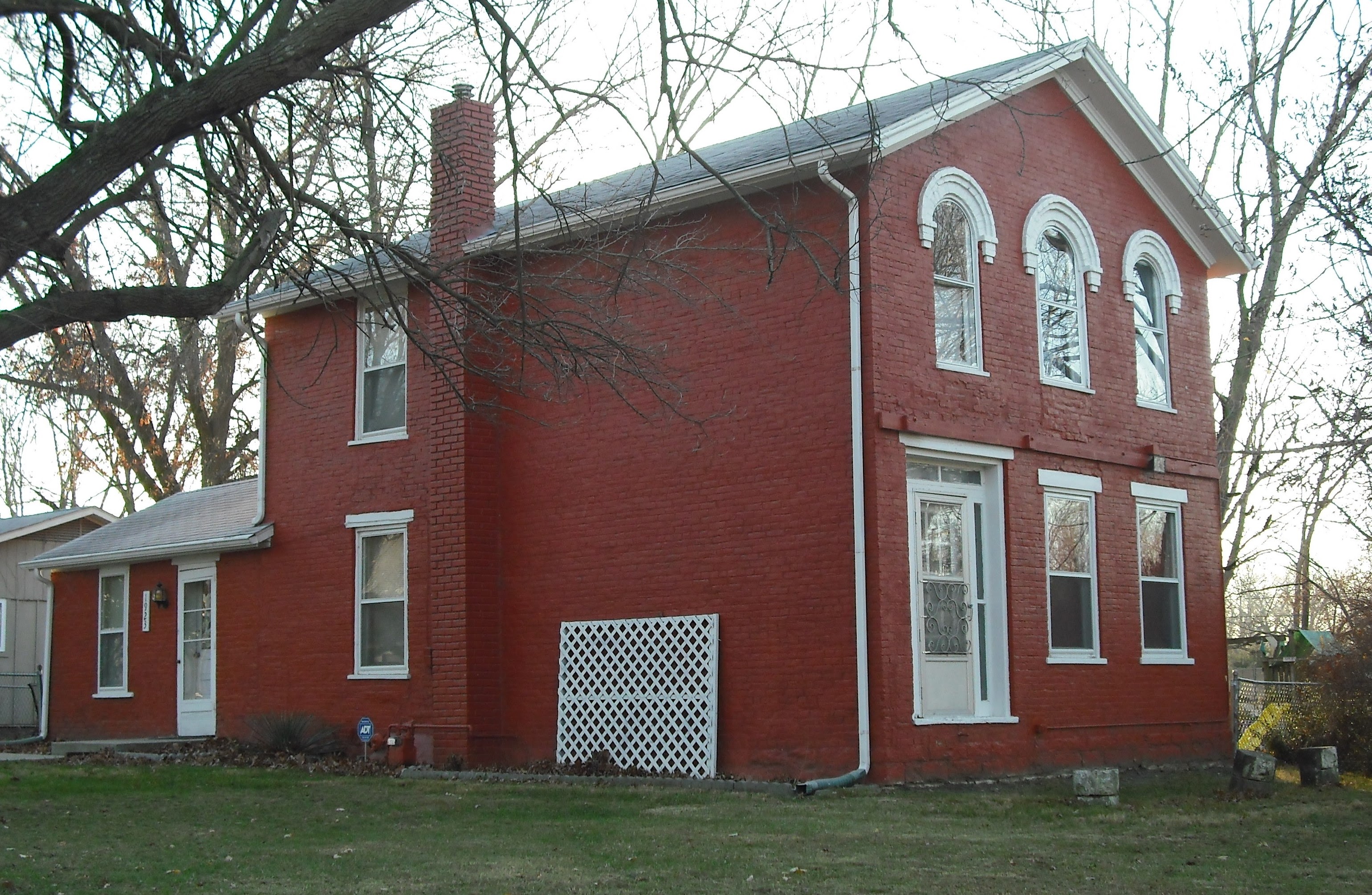
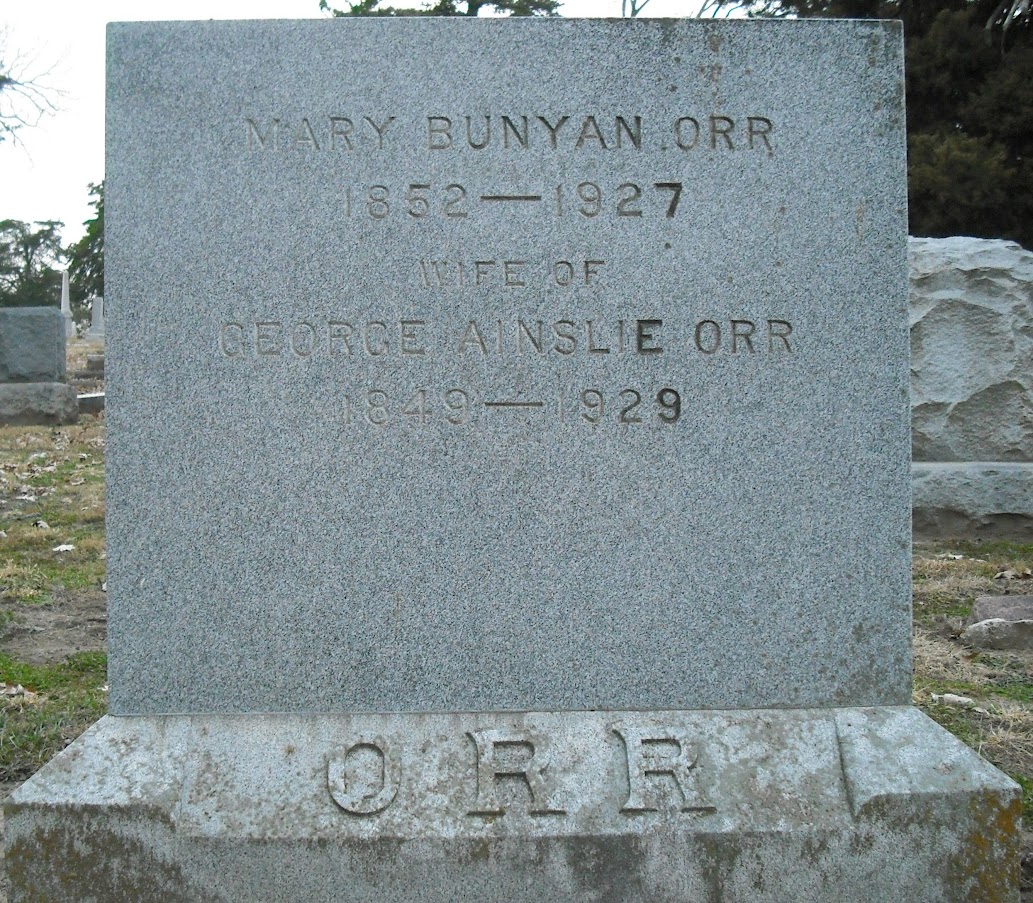
In 1887, M.H. Newlin sold his farm southeast of Lawrence to George Ainslie Orr, from New York. That same year, George had married Mary Bunion. Within only a few short years, George Orr's farm, which he called Orbundale, was a well-stocked ranch and a jewel of Wakarusa Township. 

Orbundale was located along Banks Street, now 19th Street, adjacent to the Robert Miller house. Orr also owned 320 acres of land in Willow Springs and the city directories listed his occupation as a gardener. The Orr farmhouse still stands along Clare Road. George Orr passed away in 1929, Mary passing a couple years before him in 1927. Both are buried in section 7 of Oak Hill Cemetery.

Orr farmhouse along Clare Road, Lawrence, Kansas.


Miller Spring
1857 map of northern Wakarusa Township highlighting B.W. Miller's property.
Miller Springs, also called Miller or Millerburg, was located about one mile west of Downtown Lawrence in 1854-1855 along the California Road. The land was owned by Brice W. Miller and on August 12, 1854, shortly after the first Emigrant Aid Party arrived in the Lawrence area, a meeting was held there. The meeting was for the Actual Settlers Association and was comprised of settlers who came into Kansas from Missouri.

Miller Spring was located in the southwest quarter of Section 26 of Wakarusa Township which would place it near present-day 6th Street and Kasold Drive.

Wednesday, May 13, 2020

Vivian Patee

Mary Elizabeth "Lizzie" McDermott was born in Cleveland, Ohio on January 4, 1860. At the age of 12, the McDermotts moved to the Lawrence, Kansas area where she attended the White School until the age of 16 when she got a job at the Lawrence Tribune. She was employed at the Tribune for a few years until moving to Topeka to work at the state printing office and then to the Topeka Daily Commonwealth. It was in Topeka that she met Claire M. Patee, who managed a traveling theater. They got married in 1884 and she joined him traveling around the country with the theater and soon started appearing on stage as well. It was here that Vivian Patee was born.

ad for the Patee Comedians performing
at the Bowersock Opera House in
Lawrence, Kansas. Sept. 1891.
Clarence M. Patee was born in Ashland, Kansas on May 6, 1857. Claire founded the Manhattan Mercury before becoming involved with the theater, creating his own troupe and performing a variety of plays and musicals. Around the turn of the century, the Patees quickly hopped onto the advent of motion pictures. Claire reportedly helped Thomas Edison with his work on movie projectors and owned one of the first movie theaters in the United States, located in New Jersey and opening in 1898 in Jersey City.

Taking this newfound technology, the Patees returned to Lawrence around 1903 to care for Vivian's stepfather and opened The Nickel, not only the first movie theater in Lawrence but the first one west of the Mississippi River. Patee would later open a theater in Kansas City. The Nickel was located at 708 Massachusetts Street. The location today is home to the Dusty Bookshelf.

The Patee's opened a new theater in 1913, a grand building at 828 Massachusetts Street. The Patees would continue to operate this theater until Clair's death in 1930. It would later be operated by Commonwealth Amusement. Sadly, the building would burn down in 1955 and would be demolished later that year. Part of the new J.C. Penny building (The Antique Mall) and alleyway was built in 1959.

The 1913 Patee Theater
Harlem Renaissance poet, Langston Hughes would spend countless hours in the theaters of Lawrence when he was growing up. He specifically remembers patronizing the Patee until one day he arrived to learn that they put up a sign banning black people from entering their theater. In fact, until Bowersock Theater, now Liberty Hall, opened in 1912, Hughes and the other black residents of Lawrence couldn't enter any of the movie theaters in town.

For most of 1915, Vivian suffered from stomach and bowel ailments that put her in the hospital several times. Vivian passed away on May 24, 1915 in Rosedale Hospital in Kansas City. She was only 54-years-old.

Claire continued working in the theater business. He even published a pamphlet about the movie industry trying to dispel the numerous falsities that permeated about the new industry. Claire passed away in 1930. Along with his wife, he was buried in Oak Hill Cemetery in Lawrence. She had purchased the plot shortly before her death and an elaborate gravestone was installed. The stone mentions her country origins, her time in journalism, and philanthropy but oddly leaves out her time in theater--both performing and entrepreneurship. The epitaph concludes with the journalistic shorthand for the end: "30".


If you would like to support my writing or research, you can buy me a coffee over on Ko-fi.

Tuesday, July 03, 2018

Hip-ster


I've talked about the murder of Charles Dow by Franklin Coleman that happened in Hickory Point a few miles north of Baldwin City. Dow's death was never avenged. Coleman implicated a friend of Dow's in his murder and Coleman would later go on to fight against John Brown in the Battle of Black Jack. Dow's murder happened on November 22, 1855 but nearly a year before, on November 29, 1854, Lucius Kibbee was imprisoned for the murder of Henry Davis.
an illustration of Lucius Kibbee, courtesy FindAGrave
November 29 was the day of the Territorial Election. Lucius Kibbee and N.D. Johnson were returning to Hickory Point from Lawrence along Blanton's Crossing (present-day Louisiana Street) when they passed a wagon carrying Henry Davis (not to be confused with Henry T. Davis, another settler whose family cemetery and namesake bar are located near 6th and Kasold in Lawrence). Davis and the men he was with were witnessed by Kibbee and Johnson burning down a house which angered Kibbee. When confronted, Davis asked what business it was of his. When Kibbee continued to press, Davis drew a knife and within seconds Kibbee had unloaded into Davis' stomach.

Kibbee turned himself in to Judge Elmore and was sent to stand trial in front of Chief Justice Samuel LeCompte. His trial took place on December 27, 1854 and was the second trial held in the territory. A dozen or so witnesses testified about Kibbee and Davis' confrontation. According to Johnson's testimony, after learning about the burnt property, Kibbee threatened to report Davis to the authorities. Davis threatened "I'll report you to Hell", brandished a knife and struck at Kibbee, missing him.

Kibbee passively turned away citing that he had no quarrel with Davis. Davis then swore he'd cut Kibbee's heart out and made two more lunges with the knife before Kibbee shot him right before Davis made a third lunge. The arguments were submitted and Kibbee was released on $1,000 bail until a trial could be held.

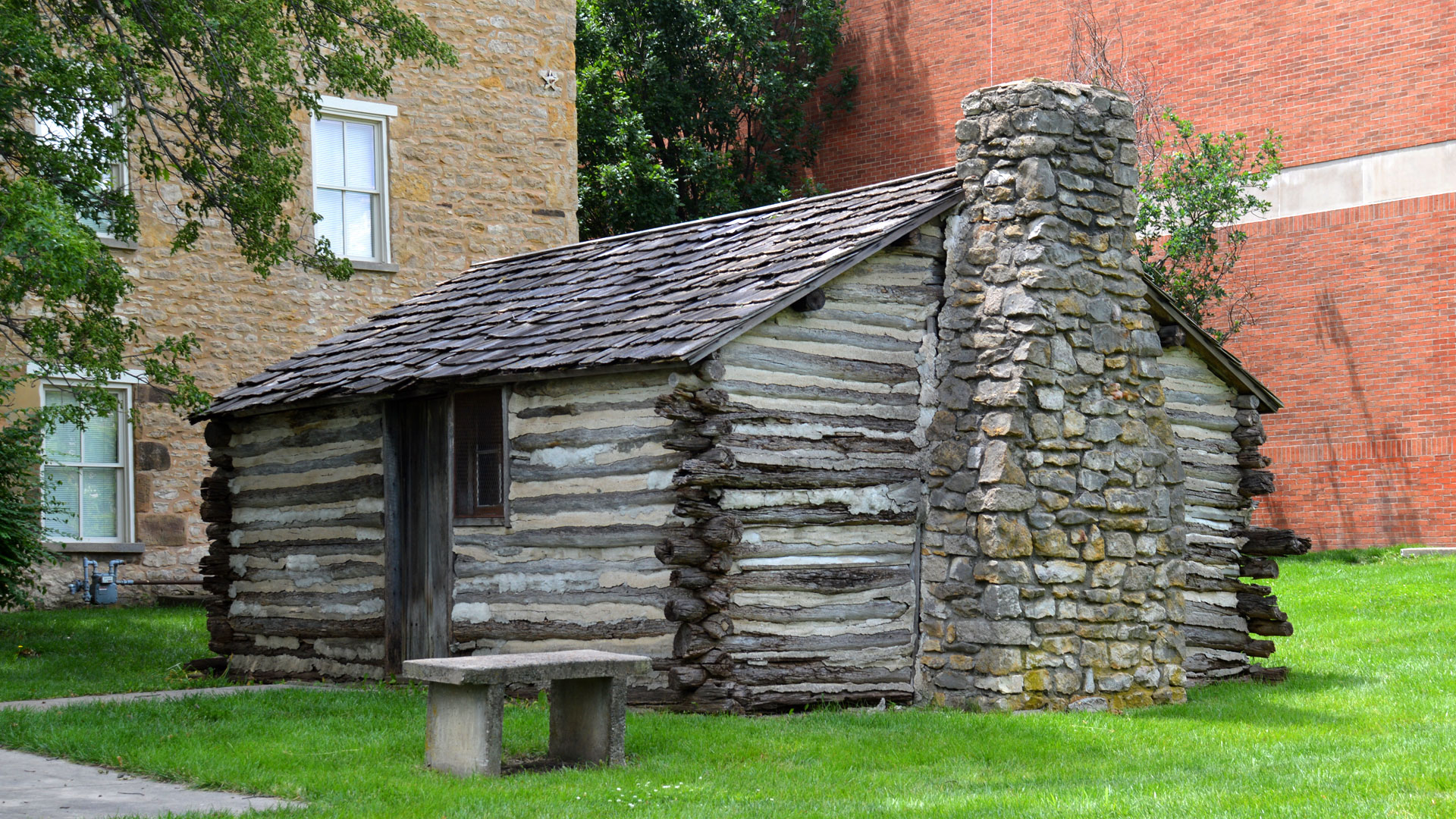
Lucius Kibbee was born in Iowa in 1815 and came to Kansas with his wife and children settling on land near Hickory Point about a mile from the Santa Fe Trail. Since preemption laws required improving the land, Kibbee built a small cabin. In July of 1854, Reverend William Goode preached the first sermon under the authority of the United Methodist Church. For months it was rumored that Missourians were going to come in from Missouri and hang Kibbee and in March 1855, Rev. Goode found the Kibbee cabin surrounded. The group was dispersed but Kibbee was charged with assault. Knowing he wouldn't get a fair trial, Kibbee gave up and returned his family to Iowa. He would later move to Nebraska where he died in 1880.
Kibbee Cabin replica at Baker University. Photo courtesy Baker University.
Kibbee's abandoned claim became property of David Jones who reportedly had slaves. When the tides turned and Kansas became a free territory, Jones left and asked Henry Barricklow to watch his land. Barricklow moved his family to the land and eventually bought the land. In 1857, at the Barricklow, formerly Kibbee, cabin, it was decided by the preachers at the Methodist convention that Baker University be established. A replica of Kibbee's cabin sits just north of the Old Castle Museum. A plaque commemorating the Kibbee/Barricklow Cabin is on private property just east of Signal Oak north of Baldwin City.

If you would like to support my writing or research, you can buy me a cup of coffee on Ko-Fi.

You know, I've seen Brutus golf with unnamed stangers, Veeblefester, Arnie, and even Wilberforce but I have never seen him play golf with Uncle Ted. Uncle Ted must not want to waste time playing golf with someone who is as terrible at it as Brutus. Veeblefester and Arnie can justify it because it's good for a few bucks or a laugh.

Here's your new hip, Uncle Ted. Whoops. Heh, heh. You'll have to go easy on it.

Thursday, August 03, 2017

POB #1: Murder Will Out!

In the afternoon of June 3, 1882, about half past four, a man's hand was found by three boys playing along the Kansas River bank in Lawrence. They alerted a nearby fisherman who watched the body while the boys ran to inform Marshal Prentice, a reporter at the Lawrence Daily Journal, who went to inform the coroner but found he was in Emporia. Bringing Dr. A. Fuller in his stead, they went back to the river to pull the body out of the river.

The body was a fair looking man. Five ten or five eleven, light complexion, blue eyes, sandy hair, dark red chin whiskers and a mustache, drilling drawers, white socks, gray woolen shirt, and red undershirt. The man also had a silver watch and a ring on a chain. Inside the ring were the initials D.B. and the date June 28, 1874. He also had several keys, a knife, several coins and other things.

The man also had eight deep gashes upon his head and the middle finger of the left hand was slit and the thumb almost cut in two. The body was taken and washed and viewed by a large number of people in hopes of verifying his identity. No one identified the body.

A coroner's inquest was held and it was determined that the victim was murdered in or near North Lawrence within the last 48 hours and thrown into the river. His watch had stopped 9:20 PM and people near the place where the man was found did hear cries near there the previous night but no other clues could be located.


Another coroner's inquest was held Sunday afternoon at 3:10 PM. One of the witnesses, Charley Allen, a young boy near the murder site, gave his testimony.

"I live in North Lawrence; am seventeen years old. Haven't seen the body. On Wednesday night between 9 and 10 o'clock I saw him killed. I was about ten feet from where he was killed. I was by the corner of the ice house; I saw Isaac King and George Robertson running up by the bank. Then I heard the man holler. He hollered three times that he would get up when they struck him. Ike King had a hickory stick about as big around as my wrist, and a hammer. George Robertson had a crowbar. They took them back to Pete Vinegar's house. I saw Dora Vinegar and Lizzie Ferguson run up to the ice houses, and they had got back to Vinegar's when I got back. Pete Vinegar was at the house all the time. Ike struck first and I heard the man holler. They didn't say anything while they were beating him. I saw the white man and Sis Vinegar and King and Robertson go up by the ice house a short time before the killing. Dora and Lizzie ran back to the house when the man hollered. They pounded him three or four minutes. I saw the man in the water that night after he had been killed, but I was afraid to stay there for fear they would kill me. King and Robertson said if they had seen me and Grant Blackman who was with me they would have killed us. Sis Vinegar, after they had hit him said 'Come on. I've got his money.' When we came back in found Sis and Dora and Lizzie and King and Robertson all standing in the yard by the fence. They all looked scared. After killing the man King and Robertson ran back together and Sis came back alone. Sis came last. Sis asked Mame Vinegar if there was any water in the house and she said no and then started after some water. She told us not to tell about it or she would kill us. Pete Vinegar didn't say anything. We told Robertson and King that we wouldn't say anything about it. They said they would kill us sure as hell if we did tell. I stayed that night at the Millers. Ike and Robertson stayed at the Vinegars. When they came back to the house Ike said they had killed a man. Mame Vinegar asked who he was and Ike answered he didn't know."

When Charley went back out the next morning, he couldn't see the body in the river or any sign that the murder had happened but he went and told his mother. The next witness was 12-year-old Grant Blackman he confirmed what Charley had witnessed and added that the man and Sis were walking together. King and Robertson snuck up behind them and hit the man. Sis got his money and told King and Robertson not to kill him. They did anyway and disposed of the body in the river.

Other witnesses included Lizzie Ferguson, Dora Vinegar, Pete and Margaret "Sis" Vinegar, and several other people. One of the witnesses was Amos Bausman of Montgomery County, Ohio, who verified the identity of the body.


David Bausman had just recently moved to the Globe area of Douglas County. He was born June 11, 1840 in Montgomery County, Ohio to Christina and Jacob Bausman. He had eight brothers and sisters. Bausman enlisted in the 74th Ohio Regiment during the Civil War. He was wounded in the Battle of Stone River in Tennessee on December 31, 1862. He married Sophie after the war and moved to Ohio Township in Franklin County, Kansas where they lived and farmed until Sophie passed away in July of 1881 at the age of 31. She is buried in Table Rock Cemetery in El Paso County, Colorado. David moved to Marion Township in Douglas County shortly after and had told friends he was heading to Lawrence this week to visit friends. While Sis Vinegar denied in her testimony that she ever saw the man, took his money, shouted, or was even there, the coroner determined that Sis lured Bausman to the banks of the river and while he was preoccupied by her, King and Robertson snuck up behind him and struck him. Sis took the money and ran while King and Robertson continued beating Bausman before dumping his body into the river. King and Robertson remained in the city until the body was found when they then fled.

David Bausman was remembered by the people of Franklin County as an honest and upstanding man who owned ample property and had money in the bank. It was never determined why he was lured to the river by Sis Vinegar but the empty whisky flask might have been part of the reason. The murder of Bausman made the people of Lawrence take stock in how much they took their peaceful town for granted especially since it was clear that they had "Benders in their midst."


On Sunday afternoon, Sheriff Asher went to Independence, Missouri where it was believed that Robertson had went. After spending several hours in town, he spotted Robertson and talked with him. Robertson turned to walk away but the sheriff drew his gun. Marshal Silvers, of Independence, grabbed Robertson and Sheriff Asher, with Robertson, returned to Lawrence around 11 P.M. Almost immediately, Robertson implicated King in the crime saying that he did it all. He also implicated a man named Draper who was already in jail. King, however, had ran away to the Kansas River bottoms east of Eudora. A posse went to Eudora and searched. Feeling them getting too close, King surrendered and he was also brought to the jail.


At about one o'clock Saturday morning, about fifty or so men went to the jail and demanded King, Robertson, and Pete Vinegar. The Sheriff initially refused but the citizens began chiseling at the wall and trying to pry the locks off the doors. After a few minutes, the men were in and dragged the murderers from their cells. They were marched to the Kansas River bridge, halted at the middle, said short prayers and then the three were then swung over the Kansas River. Most of the mob wore masks but some just had their faces blacked. As they came back down Massachusetts Street, a crowd cheered for them. It was asserted that most of the men in the lynching party were black.

The ropes were put around the men's neck in the jail. Vinegar kept proclaiming his innocence, Robertson begged for mercy, and King said nothing. Robertson went over the bridge first, then Vinegar, and finally King. Robertson and Vinegar died immediately while King was apparently strangled. The Sheriff and coroner viewed the bodies at two in the morning and ordered them cut down and brought back to the jail. A coroner's inquest was held with numerous witnesses describing the scene and what happened.

The lynching quickly made the rounds in the newspapers all across Kansas. Many were shocked that "mob rule" would be something that happened in Lawrence. Most papers felt despair and embarrassment that this happened at all in the state of Kansas, let alone in Lawrence. Rev. H.R. Pinckney called a meeting of African Americans in Lawrence and denounced what the murderers did but also the result citing that it is up to the citizens to keep 'law and order'. Rev. Dr. Cordley expressed the same sentiment that justice was not done and that Lawrence and Kansas should be embarrassed by the lynchings and the lack of true justice. Margaret "Sis" Vinegar, who was also in the jail at the time, was spared her life. For now.


Sis Vinegar plead not guilty to the murder of David Bausman and her trial began Wednesday, October 4, 1882. It was difficult finding jurors, the public mind prejudiced by the awfulness of the crime and the hangings of King, Robertson, and Sis' father. The same witnesses from Bausman's coroner's inquest were called to testify as well as new people. A large bulk of the trial focused on Vinegar's past crimes of thievery and larceny along with her carousing with other unscrupulous citizens. She was convicted of first degree murder but was granted a new trial.

The new trial of Sis Vinegar began April 9, 1883 and she was, again, convicted of first degree murder on April 12. According to the law, she would spend the rest of her life in jail. While Sis did not act directly with the murder, she had conspired with King and Robertson. She was the last player in the murder of David Bausman. She was sent to the women's state penitentiary in Lansing for the rest of her life. Her life, as it would turn out, would end on February 1, 1889 of tuberculosis. She is buried in Mount Muncie Cemetery in Lansing.

King, Robertson, and the elder Vinegar, it's reported, are all buried in Oak Hill Cemetery in Lawrence. None of them have stones and were probably buried in the potter's field in a mass grave.

Epilogue
These were not the first lynchings in Douglas County. The first occurred back in the 1850s. A group of six horse thieves were brought back to Lecompton from Rising Sun in Jefferson County and hung for their crimes. While most lynchings in Kansas were related to horse theft, a common crime in the West and one where you were immediately hanged for, there were at least 38 hangings of Negroes between the 1850s and 1930s--typically for murder or rape. And this isn't even a complete list. Dozens of rumored lynchings were reported but the time and place were vague at best. In Kansas, lynchings were always considered beyond the law. "Judge Lynch" was considered an irregular punishment and in direct defiance of the law. In fact, according to Kansas statutes, cities could be held legally responsible if a lynching happened within the city limits. Kansas law dictates that three or more people constitutes unlawful assembly and that five or more people is legally a mob. In the case of a lynching, the number of people is not specified and any group of people wanting to cause violence to a person with disregard of the law is a mob.

When the Ku Klux Klan used its influence in Kansas in the 1920s, lynchings were still non-existent. The KKK would tar-and-feather and, once, kidnapped and flogged the Catholic mayor of Liberty. Wanting to tamp down, Kansas Governor Allen issued a proclamation banning the wearing of masks on public streets and ordered them to register as a business, which would never be granted. The KKK lasted in Kansas from 1922 until 1927 before it was finally ousted.

For an incomplete list of all lynchings in Kansas plus a brief history, the book History of Lynchings in Kansas is available at the Kansas State Historical Society website.

Saturday, November 12, 2016

Whiz-Bang #7: Napoleon Blanton, First Auto-Fatality In Wichita

Back in April of 1913, when Capt. Napoleon B. Blanton became the first motor vehicle fatality in Wichita, little did the populace realize the ultimate annual toll. Last year 13 persons lost their lives within the city limits of Wichita as the result of motor car travel, but so far this year there has been only one death.

Fatality figures for other recent years were: 1957–18; 1956–17; 1955–13; 1954–13; 1953–19; 1952–8; 1951–19, and 1950–6. Even so, through these years Wichita often rated the lowest in the nation in traffic deaths for cities of its size.

Looking over records at the accident prevention bureau in the traffic division of the city Police Department, an observer can see several patters. These, according to Sgt. Jim Foster and Officer R. L. Murrow, investigator, show the dangerous spots, the reasons for danger and the most perilous hours. Officers study these patterns made by the 10,000 accidents annually in the county and work all the time to promote a program of education of the traveling masses as well as strict enforcement of traffic regulations.

In the accident prevention bureau the men are convinced that strict enforcement of regulations cuts down mishaps. “We were short men until the department employed women to check meters and minor violations in the downtown district,” Foster pointed out. This released 10 men for car and motorcycle duty.

Worse Outside City
All accidents are checked by the prevention bureau and reports made. Records over the years show that about one-third of the fatalities of Sedgwick County occur outside the city of Wichita. “Areas beyond the limits do not have nearly a third of the accidents but what they have usually are bad ones,” Foster explained. That’s a result of higher speed, according to the men who investigate.

The accident peak occurs between 3 and 7 p.m. Mishaps during those hours, however, usually are not the bad ones. They mostly mean fenders bent and bumpers torn off. Most of them are the result of fatigue from the day’s work and hurry to get somewhere, the probers said. And there are more collisions on the fringes of the city than downtown.

Less accidents happen during the night hours, records show, but over the years the crash deaths have come most often during the night.

The accident prevention bureau’s records also reveal the reasons for these accidents–fatal, or injury, or only vehicle damage. The entries go: “ran stop sign,” “excessive speed,” “failure to yield right-of-way,” “drunk driving,” “pedestrian crossing street diagonally.”

As in the case of Captain Blanton, often it is the aged person or the toddler–least able to get out of the way of a speeder–who is the victim.

Here 110 Years Ago
Captain Blanton was one of Kansas’ earliest residents. He came to the state as a settler in 1854, but prior to that time–in 1848–he had charge of a government train of wagons on the old Santa Fe Trail. During those years he had many Indian encounters. He had passed through the country where Wichita is situated when it was only Indian hunting grounds. His interesting repertory of stories contained one about camping on the future site of the city in 1849.

But in 1854 Blanton, who had been born in Polk Count[y], Mo. in 1829, settled down at Lawrence, Kan. where he built a toll bridge across the Wakarusa River, four miles south of town.

That was the year of the Kansas-Nebraska Act and a history-making time in the state. The personal story of the man who became Wichita’s first motor vehicle fatality was wrapped up in the history of Kansas.

During the border wars, he served under Capt. John Brown in a number of famous territorial battles. He fought with Captain Walker during border troubles and with Col. James Lane at Titus’ place near Lecompton, Kan. It is easy to conclude that the young bridge-building engineer was for abolition of slavery.
The toll bridge often netted $40 a day, which was an enviable income in the middle 1850s, and the Blantons 
built the first two-story log house in Lawrence.

Missed Chance for Fame
Blanton and his family moved south. The railroad tracks were crossing into southeastern Kansas. He was a surveyor. When a town was to be named a coin was tossed to see which name of the railroad builders would appear on the new depot and the maps. The coin decided it was to be Coffeyville, not Blantonville. Again, when a town was started farther to the northeast, his keen perception dictated use of the name of a leader of a nearby community in order to sway sentiment and trade toward Humboldt. In 1955, Mrs. Lester A. Heckard of Hillcrest Apartments was a guest of honor at the 100th anniversary of Humboldt, the town her father had been instrumental in starting.

Mrs. Heckard was the youngest of 11 children and her memories are vivid about the years when Captain Blanton was helping to develop south-central Kansas. But in the meantime the family lived in an 11-room home at Coffeyville and the father went to the Territorial Legislature from Allen County.

In Civil War
In 1862 he raised a command for the Union Army which became known as the Fourth Kansas Infantry. His regiment made a gallant record during the war. He was on duty at Washington, D.C. and at Georgetown for a time and under General Sheridan at New Orleans. Mrs. Blanton made her home in Washington during the war years and was in Ford’s Theater the night Abraham Lincoln was shot.

After the war he represented his district again in the legislature, always on the Republican ticket.

From Allen County the Blantons went to Abbyville, Kan. where he was president of a land company that was developing that city. In 1878 he moved to Barber County.

There it was that Mrs. Heckard recalls the family home, so fine in those days, built of frame when most houses were soddies. A tornado had taken the roof off the Blanton soddie. Her father had hauled lumber 90 miles from Wichita to the farm near Hazelton.

She recalls her father as being a man who accomplished big things. They had a 40-acre orchard and a steel windmill supplying water to the back porch. That was a modern home, indeed. The house had eight rooms, was two stories high and cost $2,000.

There the Blantons lived the excitement of pioneer days with proverbial hospitality and the graciousness typical of a good provider.

After Mr. and Mrs. Heckard moved to Wichita in 1903 and following Mrs. Blanton’s death, Captain Blanton came to reside with his daughter here. His love for growing plants continued to the end of his life and played a part in the accident which caused his death.

Struck by Auto
On that April 29, 1913, when Wichitans were shocked by the first motor vehicle death, Captain Blanton, past 83 years of age, had gone to the vacant lot a few blocks north of the downtown area where he liked to have a garden. On the way home he stopped at Dunn’s grocery. Mrs. Heckard related, to buy some of the fresh vegetables he enjoyed raising later in the season. These he was bringing home to her. He stepped onto the street and was hit by a vehicle which was said to be on the wrong side. He never regained consciousness.

Mrs. Heckard, although bitter about the incident, has continued to drive her automobile through the years. A few months ago, when she had a broken bone in her left leg, she got tired of depending upon someone else, and again operated her car with perfect ease and no mishaps by using two hands, a right foot and her usual cool head.

-The Wichita Eagle, February 1959
This article originally appeared at The Point of Beginning.

Napoleon Bonaparte. Image from Find A Grave.
The ruins of the Blanton house south of Lawrence, burned during the Lawrence Massacre.

Saturday, June 27, 2015

1225: NuPenny's Last Stand

It's Free State Festival Week in my hometown where my city becomes about 25% weirder. An art installation sponsored by the University of Kansas's Spencer Museum of Art is a NuPenny Toy Stand by Randy Regier. The location is secret but if you know people who have found it, they will tell you or you could probably figure it out. I figured out its location based on the pictures people were posting.

It was actually quite cool and I'm glad we all went out to look at it before the artist gave every one directions today.


Is Wilberforce thinking about becoming a vegetarian or is he just asking a random question in order to learn more about Hattie? I've thought about becoming a vegetarian but those thoughts don't last long as I love meat--all kinds. I know how we get our meat. It's disgusting but just about everything we do is disgusting when you really think about it.

Come on. Do it. Really think about it.


Thursday, June 25, 2015

1223: I'm Sure He'll Still Have Room for Supper

Lawrence was the capital of Free-State Kansas back in the days of Bleeding Kansas and the Civil War so you wouldn't think there would be any Confederate soldiers buried here but there is. There is only one and you wouldn't know where to look unless you knew he was there.

Private Gray Boulware served in the 9th Virginia Cavalry. The 9th was formed in January 1862. It was commanded by Colonels Richard L.T. Beale, John E. Johnson, William H.F. Lee (a son of General Robert E. Lee) and Thomas Waller. The 9th saw battles at, among others, Second Manassas, Fredericksburg, Gettysburg and Williamsport. Late in the war, they skirmished around Richmond and Petersburg.

The Boulware's were a prominent family in South Carolina and Virginia. I don't know when or why Mr. Boulware came to Kansas but on February 13, 1895, he died in Topeka of "paralysis."
News release of Mr. Boulware's passing from the Lawrence Daily Gazette,
February 14, 1895.

Pvt. Gray Boulware's gravestone in Oak Hill Cemetery.
I've never understood eating popcorn outside of a movie theater. When I think of getting a snack, popcorn never even makes the list and I usually have a pretty long list of snack foods. One of my favorite snack foods was Totino's Cheese Nachos. They were essentially pizza rolls except instead of pizza flavored insides, they were nacho based. My favorite was cheese but the beef were pretty good, too. I guess they don't make them anymore and I can't even find a picture of them online. Those things on Brutus' plate kind of look like them. Maybe Brutus hoarded them. They'd only be about ten or so years old now. They'd still be good.

Tuesday, June 09, 2015

1211: In the Style

Over the weekend, my son and I took a tour of the Hidden Valley Girl Scout Camp located in the center of town. It's 40 acres of untouched woodland surrounded by development and two major five lane streets. It was willed to the Girl Scouts in 1956 by Alfred Bromelsick who willed his entire estate to youth groups in Lawrence. The land is owned by a non-profit not by the Girl Scouts but Girl Scouts are free to use it whenever and the camp can be reserved by other groups.

They only open the camp to the public for an hour every year for trail tours. I was finally able to go on one and took some pictures. It's the year of the 17-year cicadas so when we would walk by some trees, clouds of cicadas would just pour out covering us. It was really cool. It was also very wet and muddy from the 57 inches of rain we've had in the last two months.

 Flagpole Hill and a red elm tree near the entrance. The flagpole and tree are used by the Girl Scouts for opening ceremonies and other things.

 The Hidden Valley Friends Memorial Garden This garden, with a bench and brick patio, serves as a memorial to friends of Hidden Valley. It features many varieties of native flowers and plants.

 A stone stair walkway with a latrine at the top. The latrine is the last working one in the camp. The city has said that when the latrines get full or break, they cannot repair or replace them.

 One of the campgrounds.

Once a farm pond, this body of water was converted into wetland. Nearby are trees dedicated to Hidden Valley organizers Carolyn Blaas and Mariana Remple.

A primitive wooden bridge passing over a creek.

Another one of the many campgrounds. There are numerous campgrounds each offering their own uniqueness.

 Looking down at one of the creeks from one of the wooden bridges. With all the rains, the normally dry creeks were flowing heavily.

 A tree house, built around an Osage Orange tree, in another of the campground.

 A cottonwood tree covered in cicadas.

 We got to see a snapping turtle on the tour which was really cool.

 Another wooden bridge spanning a creek.

Another campground and the last one we saw in the tour.

"Maybe because I don't like berries, or yogurt, and I don't know what 'parfait' means but I'm pretty sure I won't like that either! Give me some apple pie with ice cream, dammit!"

Thursday, April 23, 2015

What's In a (Street) Name?


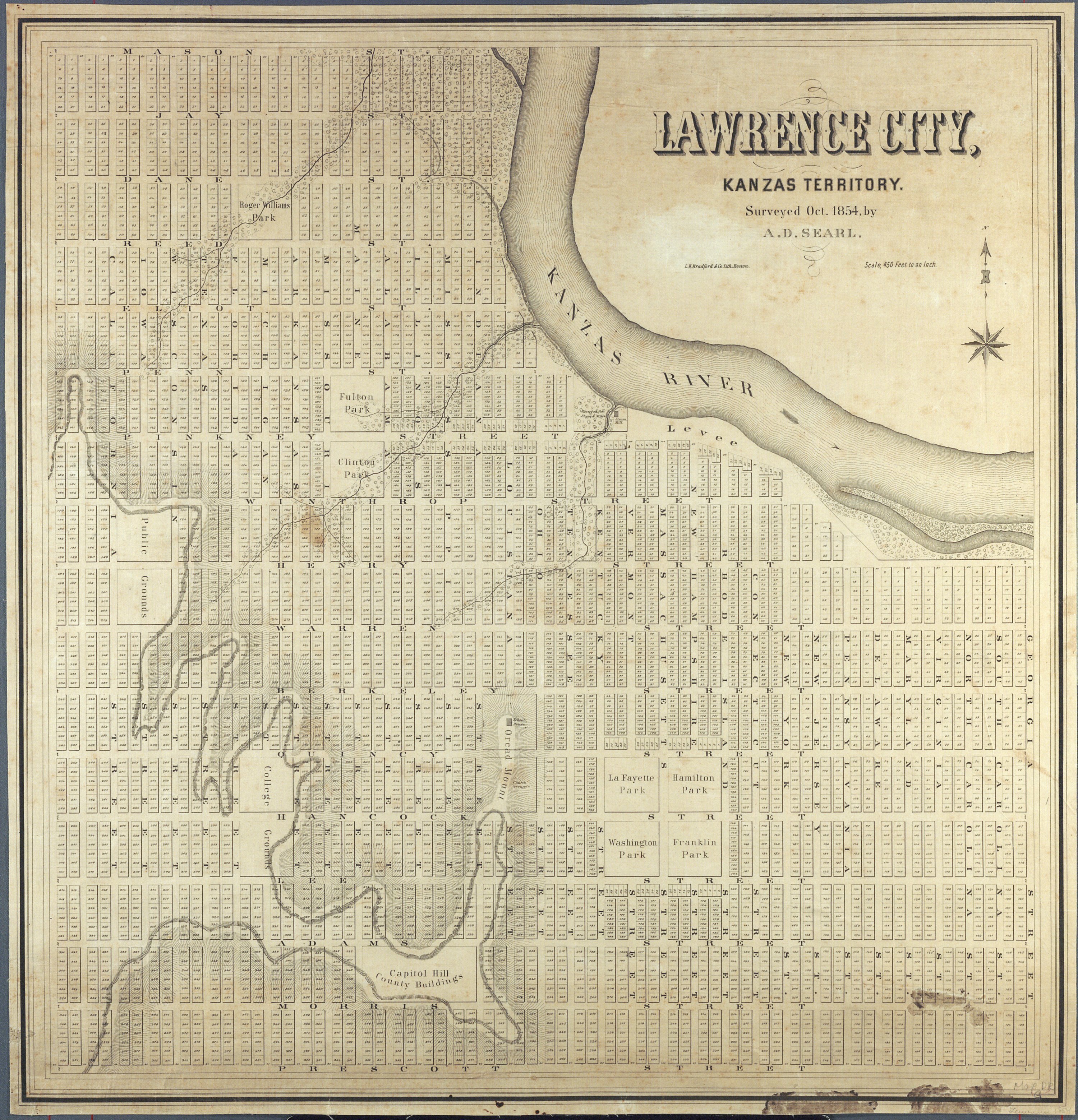
When Lawrence was originally platted, north-south streets were named for the states in the union starting with the order they were admitted in the east. East-west streets were named after Revolutionary War heroes. The state street names begin with Delaware Street about two blocks west of Haskell Avenue. Interestingly, Oregon Street was placed between Delaware and Haskell sometime before 1960, New York (the 11th State) is where Georgia should be and Georgia has never been added to the city. Connecticut and Massachusetts Streets should be right next to each but are instead separated by Rhode Island (13th State) and New Hampshire (9th State) Streets. There is also no North or South Carolina (a Carolina Street does exist near Lawrence High School however, as does Virginia Street) exists.

After passing Massachusetts Streets, the streets follow the order pretty regularly: Vermont, Kentucky, Tennessee, Ohio, Louisiana, Indiana, Mississippi, Illinois, Alabama, Maine, Missouri, Arkansas, Michigan and Florida. Next should be Texas Street but instead it's Minnesota followed by Colorado and Wisconsin and then Iowa Street (the main north-south thoroughfare through Lawrence) ends the state street naming. Lawrence doesn't have streets named after Alaska, Georgia, Hawaii, Idaho, New Mexico, Texas, Washington and Wyoming. And it's been pointed out that if the correct naming had been retained, Kansas Street would be roughly where Iowa Street is, thus making the name a bit more fitting. Instead, Kansas Street is located in the Park Hills Neighborhood off of Louisiana Street.

The east-west streets are now numbered streets after being renamed in 1913. Ironically the numbered streets begin with 2nd Street and not 1st Street. Originally, they were named for Revolutionary War heroes.

Mason Street (should be 1st Street) was probably named for George Mason (1725-1792), one of the Fathers of the Bill of Rights.
An old street sign at 3rd & Indiana in the Pinckney
neighborhood. These old signs are quickly being
replaced with newer ones.

Jay Steet (2nd Street) was probably named for John Jay (1745-1829), influential Founding Father and first Chief Justice of the Supreme Court.

Dane Street (3rd Street) was probably named for Nathan Dane (1752-1835) a Continental Congressman who authorized the Philadelphia Convention to amend the Article of Confederation which later became the United States Constitution.

Reed (4th Street) was probably named for Joseph Reed (1741-1785) who served as a Colonel in the Revolutionary War and later became Secretary of State in New Jersey.

Penn (5th Street) was probably named for John Penn (1741-1788) who signed both the Declaration of Independence and the Articles of Confederation.

5th & Ohio, also in the Pinckney neighborhood.
Pinckney (6th Street, the neighborhood and school) was probably named for Charles Pinckney (1757-1824) who was a governor, Senator and signer of the U.S. Constitution.

Winthrop (7th Street) may have been named after the influential Winthrop family whose members founded the Massachusetts Bay Colony, served as governor of Connecticut and noted Harvard professor.

Henry (8th Street) was probably named after Patrick Henry (1736-1799) a signer of the U.S. Constitution and noted for saying "Give me liberty or give me death."

Warren (9th Street) was probably named for Joseph Warren (1741-1775), a doctor who participated in the Battles of Lexington and Concord and Bunker Hill.

Berkeley (10th Street) may have been named for William Berkeley, a governor from Virginia in the 1600s. I couldn't find any noted Revolutionary War era people named Berkeley.

Quincy (11th Street) was probably named for Josiah Quincy, a Revolutionary War soldier who served alongside George Washington.

Hancock (12th Street) was probably named for John Hancock (1737-1793), signer of the Declaration of Independence.

Lee (13th Street) was probably named for Henry Lee III (1756-1818), who would become a Major General and the father to Confederate General Robert E. Lee.
The street signs in Old West and East Lawrence
note the current name and the historic name.

Adams (14th Street) was probably named for Samuel Adams (1722-1803) a Founding Father who would serve as governor of Massachusetts.

Morris (15th Street) was probably named for Robert Morris (1734-1806), a signer of the Declaration, Articles of Confederation and the Constitution and was considered, after George Washington, the most powerful man in America.

Euclid (16th Street) may have been named for Euclid, Ohio, one of the first cities established outside the original Thirteen Colonies. Euclid was founded in 1796 by a lieutenant in the Revolutionary War, David Dille.

Ontario & Sherman (17th Street) Ontario was named for Fort Ontario in Oswego, New York which was one of several forts built by British to protect the east end of Lake Ontario from the French. Sherman was probably named for Roger Sherman (1721-1793), an early lawyer and politician of our country. He was the only person to sign the Continental Association, the Declaration of Independence, Articles of Confederation and the U.S. Constitution.

Sherman ran from present-day Naismith Drive to Louisiana; Ontario ran from Louisiana to Connecticut.

Rogers & Bews (18th Street) Rogers may have been named for George Rogers Clark (1752-1818), one of the most decorated military officers in the Revolutionary War. I was unable to locate information on the name Bews.

Rogers ran from present-day Naismith Drive to Louisiana; Bews ran from Tennessee to Vermont.

Banks & Leis (19th Street), it's here where the names seem to change from American Revolution honors to Civil War ones. Banks may have been named for Union General Nathaniel Banks (1816-1894) since Banks/19th would've been added after the Civil War. I was unable to verify who Leis might be named for but there was a Civil War solider named John Leis that I found several mentions of.

Senator (20th Street) Clearly I am not going to be able to verify why this street was named Senator. The name could have been chosen to honor Senator James Lane (1814-1866), who moved to Kansas in 1855 and became a staunch abolitionist and Union general, or Senator Stephen Douglas (1816-1861), namesake for the county and prominent politician during the Bleeding Kansas days.

Merchants (21st Street) A common street name, I am unable to determine if this street was named for past businesses that may have been located along this street or to honor someone with the surname Merchants.
22nd & Rhode Island in the Barker
neighborhood.

Carmean & Hosford (22nd Street) I found only minor instances of the names Carmean and Hosford in the Civil War: David Carmean and John Hosford., who you can more about here.

Bishop (23rd Street) I could not find a namesake for what would become the major east-west thoroughfare through Lawrence but found a guy named Richard M. Bishop (1812-1893) who we can all imagine was the namesake. There is a chance that it was named for Reverend William Bishop who presided over the Presbyterian Church from 1858 to 1860.

Not mentioned in this post but Mechanic
Street was probably named for the industrial
businesses centered around it and railroad.
In North Lawrence, east-west streets are your standard city street names, named after trees: Elm, Locust, Walnut, Oak, Hickory, Ash and Maple. There are few street names in honor of people such as Lincoln (Abraham Lincoln, 1809-1865), Lyon (Gen. Nathaniel Lyon, 1818-1861, the first Union general killed in the Civil War), Perry (possibly named for John D. Perry, 1815-1895, president of the Kansas Pacific Railroad that was built through North Lawrence), Lake, may have been named for the lake at Bismarck Grove that was stocked with swans every year for the Bismarck Grove Fair, Funston (Edward Funston, 1836-1911, represented Lawrence in the U.S. Congress from 1884 to 1894 and was the father of Medal of Honor recipient Frederick Funston) and Maiden, I was unable to find an origin for this name which probably differs from the Maiden Lane in New York City which was named for the women who lined the street cleaning their laundry in the now-long-gone creek. Another street, Grant Street, was more than likely named for Grant Township, the township North Lawrence sits in which, in turn, was named for Ulysses S. Grant after being annexed to Douglas County in 1870 from southern Sarcoxie Township in Jefferson County.

The north-south streets are now numbered with North 1st, North 2nd, North 3rd to North 9th Streets but before they were numbered they were given state street names that corresponded with  their southern alignment. North 4th was New York Street, North 5th was Pennsylvania, etc. They were renamed with the southern numbered streets in 1913.

Disclaimer: These are based on my own research and may be inaccurate. I have researched each name and consider this list as correct as possible. If you feel that I have erred somewhere, please let me know via the contact form.