Showing posts with label Topeka. Show all posts

Saturday, January 17, 2026

Topeka, Eskridge & Council Grove Railroad

Proposed routes for the Topeka, Eskridge
& Council Grove Railroad. You can view
an interactive map here.
In 1903, it was proposed to create a railroad line from Topeka, following the Mission Creek Valley, through Eskridge, and on to Council Grove. It was to be known as the Topeka, Eskridge & Council Grove Railroad. As with such projects, some people were for it and others against it. Dover and Auburn fought over which city the railroad should go through, Eskridge worried the railroad would harm their businesses, and Council Grove was excited to have a railroad connection to Kansas towns east.

Osage Free Press, Dec. 16, 1903

Ranchers in Wabaunsee County were excited to use the new railroad to haul their cattle to Kansas City and smaller towns, like Halifax, were excited for a possible population boost. Plans were made to expand the railroad to Emporia (as seen above) but also to Burlington, Tonganoxie, and Brown County(!). But that wasn't all. Proposals for the track to be used to bus Washburn University students to and from their nearby hometowns were made. They tried to even hype up the Rock Island and Santa Fe railroads that having a railroad running directly between their lines would help them. The extensions to Burlington and Pierce Junction were specifically to attract attention of the Santa Fe and Missouri Pacific railroads.

Despite being told in 1905 that there was not enough population to warrant a railroad, Topeka and Council Grove continued to push it. In 1906, now renamed the Topeka & Southwestern Railroad, officers were elected to plan a route and secure money for the railroad. The routes they chose, expanding the plan to two lines were selected in late 1906. The estimated locations are in the map above. Work started in November 1907 with a dirt moving ceremony on Washburn university campus. This gesture was apparently just ceremonial.

W.L. Taylor, of Taylor Grain Co. who was the president of
the Topeka & Southwestern. The vice president was Charles King
Holliday, son of Topeka and Santa Fe Railroad founder, Cyrus Holliday.

The right-of-way was extended in 1909 for another year and some grading was done in Morris and Dickinson counties and in Topeka but little work moved beyond that. In 1912, some of the grading in Morris and Dickinson was purchased by another railroad. In 1913, C.A. Magee urged Topeka to commit bonds to building the railroad from Topeka to Dover, hoping to spur development. They refused and finally the Topeka & Southwestern died.

The Arkansas City Daily News of April 18, 1914 reports "Southwest of Topeka there is a railroad grade of the Topeka & Southwestern and near Council Grove there is some more grade for the same line. In several places in Kansas may be found the grades of railroads of great promises but which were never built."

The grand plans for the Topeka & Southwestern Railroad. Though not mentioned in any article, it
was apparently planned to extend the Council Grove line to Marion, Kansas and have a line running
south out of Topeka to Garnett.

Saturday, January 10, 2026

Holliday Park Fountain

Given to the city of Topeka by the National Humane Alliance--a foundation created to provide fountains to horses (and other animals) in high-traffic areas--this fountain was originally planned to be installed at Gordon and Kansas in North Topeka. Ultimately, Lewis Sever, the person from the NHA who had the final say, decided the fountain should be placed at 6th and Quincy.

In 1929, deemed a traffic hazard--it was in the middle of the street after all--it was moved to the warehouse district near the river and many other places according to news reports. In the 1970s, it was given to the Topeka Round-Up Club to be restored but that never happened. In 2000, it was given to the Holliday Park Neighborhood Improvement Association for restoration and reinstallation in Holliday Park.


Saturday, January 03, 2026

William Ward Harding

Around 1902, a young boy was born in Pennsylvania. His mother died shortly after giving birth and he was placed in an orphanage under the name Elmer LaPelle. In late 1906 or early 1907, a group of children were sent from that orphanage to Topeka, Kansas in hopes that they would be adopted here.
Dr. Eva Harding fell in love with little Elmer, who was considered bright, handsome, and lovable. Dr. Harding officially took custody of Elmer on January 30, 1908 and the little boy was re-christened William Ward Harding.

Sadly, on February 6, screams came from the back room of the office/apartment where Dr. Harding and Dr. May Stout lived and worked. When Dr. Stout arrived, Ward was engulfed in flames. She tried to douse the flames with a rug but was too late. It appeared that he tried to light a candle and caught his nightgown on fire.

A small funeral was held in Dr. Harding's office and Ward was buried in Rochester Cemetery in North Topeka.


Saturday, December 13, 2025

Anthony Overton

Anthony Overton became the first African American to own a conglomerate. Founding the Overton Hygienic Manufacturing Company in 1901, Overton became the premiere name in cosmetics for Black people.

Born in Monroe, Louisiana on March 21, 1865, Overton's father was an emancipated slave and was a small business owner. Overton's father also served in the Louisiana legislature for four years. Some time prior to 1880, the Overtons moved to Topeka, Kansas. Overton's father made sure any opportunity was awarded to his son. Overton attended Washburn University, graduating with a degree in chemistry. He then attended the University of Kansas law school, graduating in 1888. He practiced law and even served as a municiapl judge in Topeka for a short time.

In 1898, Overton started the Overton Hygienic Company, originally selling his products in his own grocery store in Topeka. He moved to the North Park neighborhood near North Topeka in 1901 where he established a factory along the railroad line. Hygienic manufacturing companies specialized in baking powders and sodas along with other kitchen cleaners and toiletries. Overton originally made a name for himself with the Overton Hygienic Pet Baking Soda before obtaining market success with High Brown Face Powder. A post office for the hygienic plant was opened December 5, 1901 under the name Hygienic with Overton serving as postmaster. Hygienic was located about three miles west of North Topeka along the railroad. More than likely the plant was located around the Cargill elevators and behind the U.S. Foods Distribution Center. The post office closed August 15, 1903.
Possible location of the Hygienic Factory near the Cargill elevators.

Overton then moved his business to Chicago, Illinois in 1911. In 1922, Overton commissioned the Overton Hygienic Building at W. 36th and S. State streets. Besides his hygienic business, Overton also ran the Victory Life Insurance Company, Great Northern Realty Company, the Half-Century Magazine, the Chicago Bee, and Douglass National Bank. The Bee then got it's own building down the block from the Hygienic building. The Hygienic building later served as a hotel and flophouse. Currently, it is being used as shared workspace for area startups.

Overton married his wife Clara when he was in Oklahoma for a short time. It's possible that she was the true driving force behind the Hygienic Company and the High Brown Face Powder. Sadly, she passed away shortly after they moved to Chicago in 1912 at the age of 45. They had four children.
When Overton passed away in 1946 at the age of 82, the Chicago Bee folded, as did much of the other businesses, which had been hit hard by the Depression and general mismanagement. Everett Overton took over the company until his death in 1960 when the company passed into the hands of Anthony Overton III. Overton III faced a changing landscape and more competition from other Black-owned cosmetic companies. Overton Hygienic continued in stride until 1983 when it closed.

Anthony Overton's two buildings still stand along S. State Street in Chicago and are on the National Register of Historic Places. A nearby elementary school was named for Overton and was open from 1963 until 2013. Overton is not forgotten in Topeka either as Center Street in East Topeka between Adams and Chandler streets was renamed for Overton some time after the 1940s.

For more information on Anthony Overton, check out the Made In Chicago Museum.

Various Overton products showcased during a Memorial Day celebration in Topeka Cemetery in 2023.

Saturday, September 20, 2025

Boswell Square Park

Boswell Public School was constructed in 1922 on Boswell Avenue in the College Hill neighborhood of Topeka, Kansas. In 1928, the school began the junior high program and starting with the 1929 school year, it became Boswell Junior High School. The school colors were red and white and their mascot were the Wildcats.

Due to consolidation, Boswell Junior High was closed down and then demolished in 1981. Due to be replaced by apartments, the neighborhood stepped up to turn the land into a park, Boswell Square. The date stone of the school was incorporated into the wall of fame and a gazebo from Menninger's was installed along with a flower garden, playground equipment, and a basketball court. The gazebo was recently replaced with a new one as was the playground equipment but the park continues to be a centerpiece of the Historic College Hill neighborhood.

Boswell Square Park entrance sign with flower garden and playground
equipment in the background.

Boswell Junior High School

Remains of the front entrance and columns during demolition.

Vanity plate for the Boswell Junior High Wildcats

The 1922 date stone in the wall of fame.

A memorial for the school and the original gazebo.

The wall of fame and the new gazebo with Westminster Presbyterian Church in the background.

Saturday, July 05, 2025

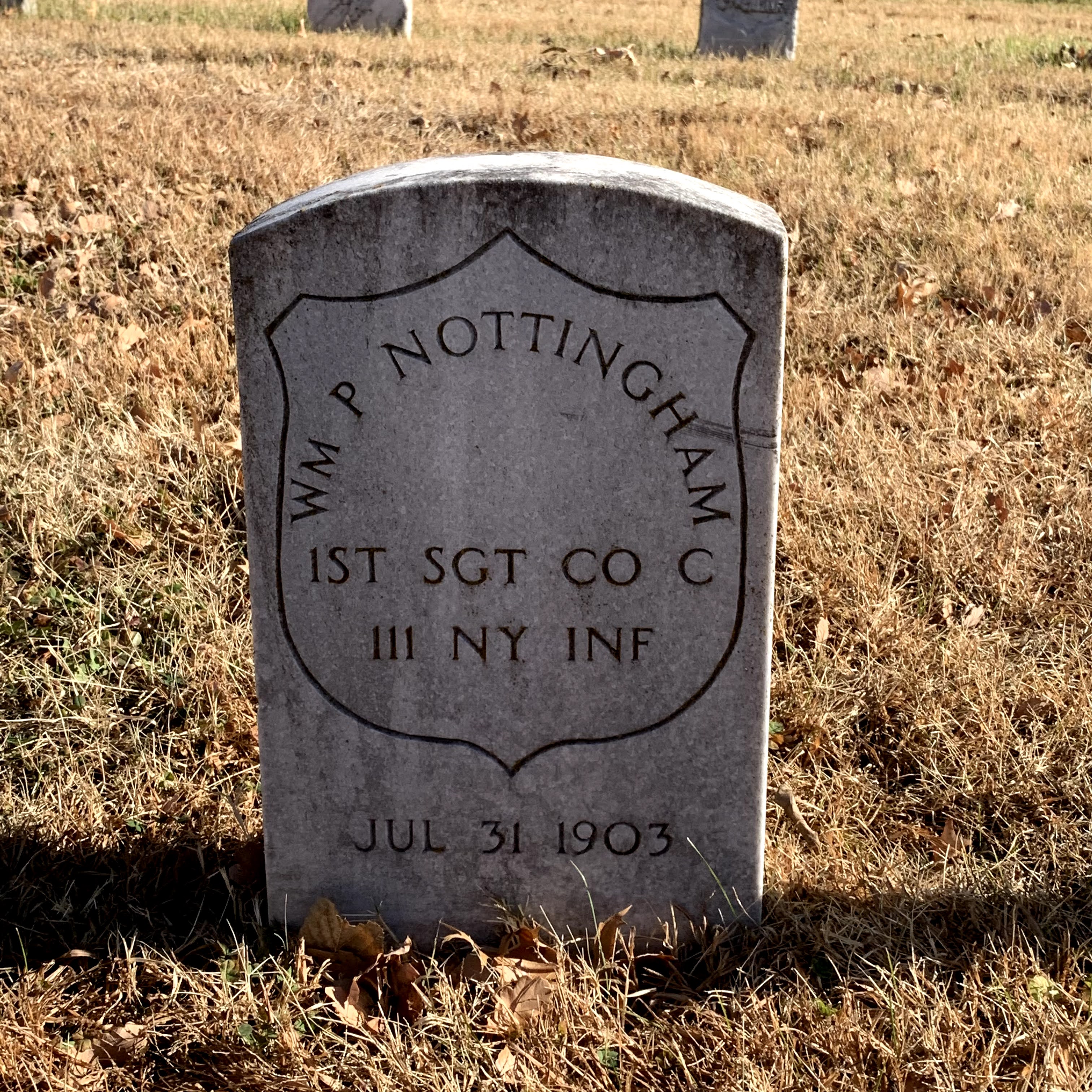
William Nottingham

William P. Nottingham was born in Palmyra, New York around 1833. He apparently never married or had children. He served during the Civil War serving in the 111th Regiment of the New York Infantry. He participated in the defense of Harper's Ferry and Washington, D.C. along with Gettysburg, the Siege (and Fall) of Petersburg, and Appomattox Courthouse among many other battles. After the war, Nottingham seemed to just wander the country mostly traveling between Kansas and Oklahoma Territory and living on a small military pension and inheritance allowance.
Nottingham took up residence in the old Curtis House at 216 West Curtis Street but was forced out due to the 1903 floods. He had been staying with J.F. Blake at 2009 Harrison but had returned to his room at the old Curtis house on July 31. Nottingham was found dead in his room later that night. Originally, it was believed death was caused by a combination of old age and alcoholism--Nottingham had sadly been a heavy drinker and taken the habit back up after the flood. Luckily, the coroner thought the death seemed suspicious and saved the stomach. A chemical analysis showed that Nottingham had more than enough morphine in his system to kill him. Focus now shifted on who had done the deed.
Frank Brown could've had a storied life and career. A lawyer, Brown even served as a deputy attorney for the city of Topeka. In 1898, Brown was arrested for passed forged checks and embezzling money. In Topeka alone, Brown passed more than two dozen fraudulent checks. Famed Topeka attorney A.H. "Hib" Case noted that "[Brown] is not insane. But when he is drinking, his mind is gone." Brown also lived in the old Curtis house which was run by his mother, Sarah. Newspaper articles from 1900 to 1913 had several instances of police going to the Curtis house because Brown was bootlegging, gambling, or just contributing to societal nuisance.
William Nottingham and Frank Brown spent July 31, 1903 together drinking and carousing around town. Around noon, Nottingham returned to his room where he ate lunch and retired to bed. Brown returned home shortly after but soon left to go back downtown. Nottingham was found dead around 5 p.m. Brown, meanwhile, appeared over the next day in different saloons and gambling houses with more money than he had ever been seen with. It is known that Nottingham had $200 on him and a search of his room yielded no money. It was theorized that Brown gave Nottingham the morphine while they were riding together in a carriage before Nottingham went home. Brown then disappeared and wasn't heard from in at least two weeks.
Nottingham was buried in the G.A.R. section of Topeka Cemetery.
There is no evidence that Brown was ever arrested or convicted of Nottingham's death. Brown did return to Topeka and, as noted above, continued being a nuisance to the people of Topeka. He continued to pass forged checks occasionally, bootlegged, gambled, and even posted advertisements violating a city ordinance. Even as late as 1921, Brown was arrested for manufacturing 5 barrels of moonshine which his then 84-year-old mother had to bail him out for. Sarah Brown was aunt to Vice President Charles Curtis and lived at 216 Curtis, one of the first houses built along the Kansas River, from 1875 until her death in 1931. She is buried in the Curtis Family Cemetery in North Topeka. Her obituary mentions Frank as living in Washington, D.C.


Saturday, June 21, 2025

The Kafton Family


Between 1820 and 1870, only 7,750 Russians immigrated to the United States. Due to land scarcity, poverty, and starvation, more than 10,000 Russians immigrated to the U.S. in 1881. Sometime between 1866 and 1881, the Kafton family arrived in Kansas to start a new life. Raised Lutheran, the Kaftons were said to be very devout.

George Conrad Kafton was born December 3, 1842 in Mariupol, Russia (now present-day Ukraine). His parents were Johann and Catherine. He married Catherina Charlotte on June 15, 1861. They had 15 children, at least four of which were born in Russia and the others born in Kansas.

They came to Kansas with Charlotte's parents, Leonhard and Johnna Philippa. They originally settled in the Hillsboro area in Marion County, Kansas, but George and Charlotte moved to Topeka. Charlotte passed away January 5, 1901 at their home on Lake Street. George moved back to Hillsboro to live with his son, John, where he lived until he passed away September 30, 1920.


Saturday, June 14, 2025

Little India May

On January 7, 1912, dozens of people gathered in the office of Dr. Eva Harding to admire a seven-month old, chubby, hazel-eyed baby girl. The baby girl was being put up for adoption and within twelve hours, hundreds would express interest in Little India May.

India May was born June 9, 1911 in a small town in Oklahoma. The mother was the daughter of a minister and India May had no father. Before arriving in Topeka, Kansas, mother and daughter were residing with a school principal in Oklahoma City. When the principal got sick and she decided to go to a spring, the mother and child were left without a home. They made their way up to Topeka on January 5 to find a relative of India's father. The relative refused to aid them so the mother sought out other help.

She first went to the Orphan's Home, but was turned away because she could not afford the cost there. The Orphan's Home was established in 1888 in a building at 3rd and Fillmore. The orphanage closed in 1947 and the building was gifted to the Capper Foundation. It was later learned that the mother was offered $4 a week to work in the kitchen to pay for the placement, but refused. The mother then went to the Provident Association. The Provident Association was started in 1904 to help people affected by the 1903 flood. It was located in a brick building at 4th & Jackson streets. It would later become Family Service and Guidance Center. However, they had no room to place India May. In desperation, the mother and child came to the office of Dr. Harding.

Dr. Harding and the mother chose a couple late in the afternoon of the 8th. Of the more than a hundred people who were interested in India May, Mr. and Mrs. John R. Graham were selected. "We are tickled to death to get her," Mrs. Graham said. John Graham worked for the Charles Wolff Packing Company as a trimmer and owned a home at 112 Fillmore Street. The Grahams did not any children of their own. "Nothing will be too good for the child," said Mr. Graham.

Information on India May and the Grahams end with the adoption. A John R. Graham is buried in Memorial Park Cemetery in Topeka having died in 1950. His wife is listed as Ada, but no children are listed with them. It could also be a case of mistaken identity as an Ada Moss was married to a John J. Graham who died around the same time. John R. Graham in Memorial Park Cemetery is buried in an unmarked grave.

Saturday, June 07, 2025

Our Darling


MARY ELIZABETH

Dau. of
W.E. & M. SEQUINE

1900 - 1903

OUR DARLING


Mary Elizabeth died of pneumonia at two and a half years old.


Saturday, April 19, 2025

The Grote Children

Edwyn and Merwyn Grote were the twin sons of Edward F. and Lotta Mae Grote. E.F. was a grocer with a store at 17th & Kansas. Lotta passed away shortly after the birth of her sons in February 1897. E.F. would remarry to Elizabeth Munn. Both are buried in Mount Hope Cemetery. Lotta and the twins are in Topeka Cemetery.

Edwyn Grote, aged 9 months, son of Mr & Mrs. F.E [sic] Grote of 1328 Tyler Street, died this morning. The child was one of twins, the other still survives. The funeral will be held at the family residence tomorrow morning at 9 o'clock." -The Topeka State Journal, July 7, 1897. According to the Topeka Daily Capital, Edwyn died of "dropsy of the brain."

Merwyn, who passed away in January 1898, did not receive an obituary that I could find.


Saturday, March 22, 2025

Anna Faidley

Anna M. Faidley was born in Evansville, Indiana in March of 1846. She married John Peter Faidley on August 21, 1895 in Topeka, Kansas and moved with him to Wakefield, Kansas, where he worked on the railroad. John would die in 1918 after being hit by a train while sitting down to rest on the tracks.

Anna practiced as a "mental scientist and magnetic healer" while in Wakefield. She promised to cure any disease without drugs and her ads were prominent fixtures in the local newspaper.


From the Hutchinson News, February 5, 1923: "Declaring in a long note that she had read her Bible through carefully and found nothing advising against suicide, Mrs. Anna M. Faidley, 77, ended her life early today by gas asphyxiation. 'It seems there is no place in the world for old persons,' she wrote." Outliving most of her close family and faced with the possibility of homelessness due to who she was living with planning to move, Mrs. Faidley decided to "end it all."


If you or someone you know is having emotional distress or suicidal thoughts, contact the National Suicide Hotline at 988.

Saturday, March 08, 2025

Chang Kim

Chang Wha Kim immigrated to Topeka, Kansas around 1900 to work for the Atchison, Topeka & Santa Fe. He was killed April 4, 1913, while cleaning an engine that was being turned on and was crushed between the engine and the wall of the Santa Fe Round House. His fellow employees took a collection to save him a pauper's burial and got him buried in Mount Hope Cemetery with a simple stone to mark his grave. Kim's death didn't even make the local newspapers until June 10, 1913 when Frank E. Forbes sued the Santa Fe Railroad for Kim's death on behalf of Kim's wife, Song.

Chang Kim came from what is now Cherowon County in Kangwon Province in South Korea. I am not positive about this because newspapers would just spell foreign place-names phonetically. In the Topeka Daily Capital, Kim's home is phrased "Whagaichon, Dawiree, Chull Won county, state of Kang Won, Korea." His marriage to Song consisted of bowing in front of witnesses followed by a feast. Song had to admit her marriage certificate as evidence when she was brought to Kansas for the lawsuit. Chang would send some money back home to Korea for his wife and elderly parents. Apparently, he didn't send very much and never wrote a letter to accompany the money. He was also apparently going to bring his family over to America when he was killed.

The lawsuit was asking for $10,000 to Mrs. Song Kim and, according to the Daily Capital, she was "an uncivilized native" from the "mountain wilds" of Korea and "had to be tamed" before going to trial. Her lawyer was Frank Drenning and a Korean student attending the University of Kansas was brought in as a translator. At the end of it all, Song Kim was awarded $2,000 and, presumably, returned to Korea.


Sunday, October 30, 2022

The Hicks Block


Elhanan Hicks was a Topeka realtor and capitalist who, during an economic boom in the 1880s, acquired a permit to build a tenement and business flat at present-day 6th and Tyler. The initial plan was estimated to cost $20,000, but eventually rose to an actual cost near $50,000. During the 1880's boom land values skyrocketed, and confidence and optimism supplanted forethought. Hicks Block was built at the apex of the boom, but eventually the depression found its way to Topeka and took a huge toll. The population dropped an astounding 5,511 people during the 6 years after the boom, and with them many businesses and investments. Elhanan Hicks was one of the casualties of the depression, summarily disappearing from Topeka directories after 1891.

Soon after, Hicks Block was converted into apartment homes and continues to serve temporary residents to this day. Being from an era when entrepreneurs would adorn their names on their buildings, Hicks Block was built to enrich the capital city for many years to come and was included in the National Register in 1977. Over the years, Hicks Block fell into disrepair despite still being occupied. Over the last few years, a new owner took over and has been restoring Hicks Block to its former glory.

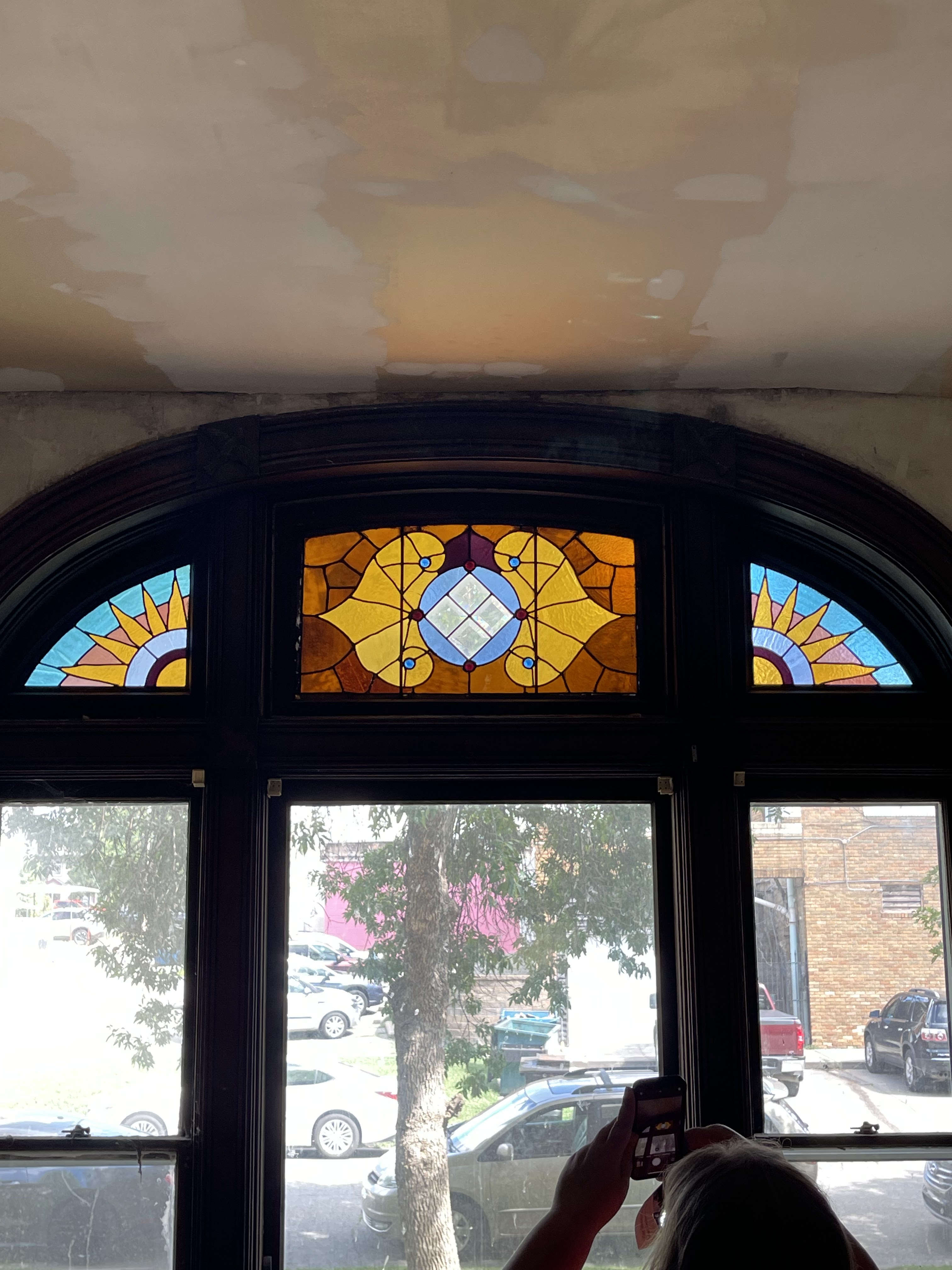
Below are photos from a tour featuring an untouched apartment and one that has been restored. The above information came from the Ward-Meade Neighborhood Improvement Association.